Why Front Teeth Matter and What Lies Beyond Implants
Missing front teeth can dramatically affect a smile’s appearance, speech clarity, and chewing efficiency, often leading to lowered confidence and facial‑structure changes over time. While dental implants remain the gold‑standard—offering a 97% ten‑year success rate, bone‑preserving titanium or ceramic posts, and a lifelong solution—they require surgery, possible bone grafting, and a longer recovery. Non‑implant alternatives such as traditional and cantilever bridges, minimally invasive resin‑bonded (Maryland) bridges, and removable partial or full dentures provide effective, less costly options that avoid surgery and can be placed in fewer visits, though they do not stimulate the jawbone and may need periodic replacement. Best Choice Dental in Totowa, NJ, leverages advanced CAD/CAM technology and a full suite of restorative and cosmetic services to tailor each treatment—whether implant, bridge, or denture—to the patient’s oral health, aesthetic goals, and budget, all delivered in a comfortable, family‑oriented environment.
Non‑Implant Restorations for Front Teeth
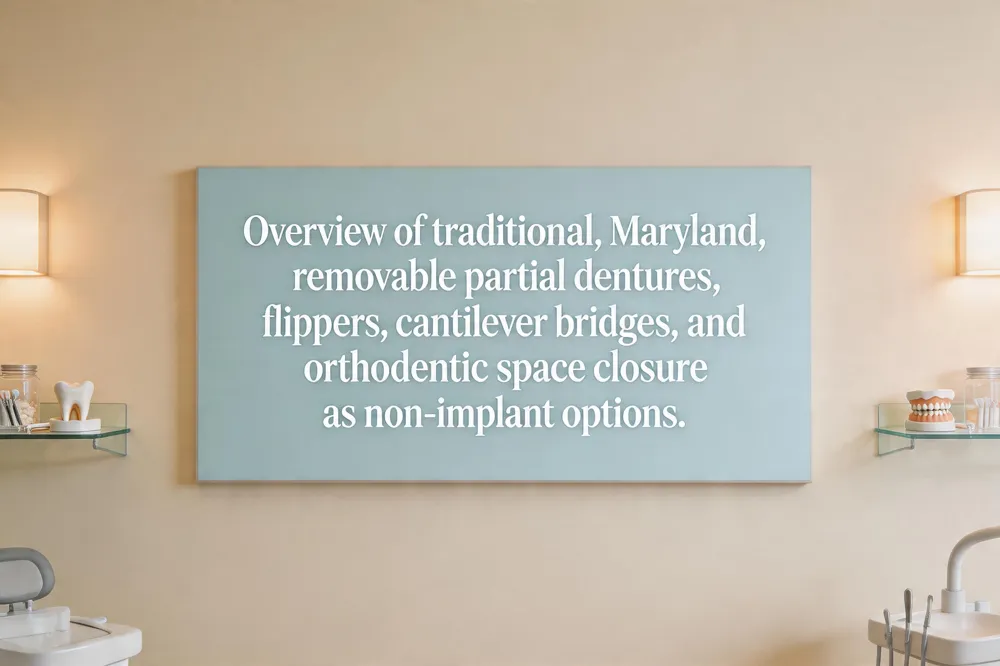 When a front tooth is missing, Best Choice Dental in Totowa, NJ offers several non‑implant solutions that balance aesthetics, comfort, and cost. Traditional bridges use crowns on the neighboring teeth to hold a pontic, providing a durable, fixed restoration that lasts 10‑15 years with proper care. For a less invasive option, a Maryland (resin‑bonded) bridge bonds a thin metal or porcelain framework to the backs of the adjacent teeth, requiring little or no tooth reduction and often costing $500‑$1,200 per unit.
Removable partial dentures replace one or more front teeth on an acrylic base with metal clasps; they are affordable (often $300‑$800 per arch) and can be taken out for cleaning. When all teeth in an arch are missing, a complete denture restores function and facial support without surgery.
Orthodontic space closure uses braces or clear aligners to shift neighboring teeth and close the gap, eliminating the need for a prosthetic tooth altogether.
Cost‑effective alternatives include flipper teeth (temporary acrylic partials under $200), cantilever bridges (slightly cheaper than two‑abutment bridges), and resin‑bonded Maryland bridges, which are less expensive than conventional fixed bridges while still offering a natural look.
FAQs:
- Cheaper alternative to a bridge? A removable partial denture or a Maryland bridge.
- How to fix missing teeth without implants? Use a traditional or Maryland bridge,, removable partial/complete dentures, or orthodontic closure.
- Best veneers for missing teeth? Veneers cannot replace a tooth; combine an implant‑supported crown or bridge with porcelain veneers on surrounding teeth for seamless aesthetics.
- Good implant alternative? Tooth‑supported bridges, removable partial dentures, or Maryland bridges.
- Back‑tooth alternatives? Metal‑ceramic fixed bridges, cantilever bridges, or removable partial dentures.
- Cheap implant alternatives? Traditional bridges, Maryland bridges, partial dentures, flippers.
- Overall cheap options? Removable partial dentures, acrylic bridges, Maryland bridges, and flippers.
Cosmetic Veneers and Their Role When Teeth Are Missing
 When a tooth is gone, a veneer alone cannot fill the gap because veneers need a healthy tooth surface to bond to. The best approach is to first replace the missing tooth with a permanent solution—such as a dental implant, a fixed bridge, or a removable denture—and then use custom‑made porcelain or composite veneers on the surrounding teeth for a seamless, natural‑looking smile. For patients who are not implant candidates, a Maryland (resin‑bonded) bridge combined with veneers on the adjacent teeth offers a durable, aesthetic result.
Snap‑on or pop‑on veneers are removable, thin shells that clip onto existing teeth to mask a small gap, but they are purely cosmetic, do not restore function, and are best used as a temporary option while planning a permanent restoration.
Clip‑in veneers work similarly and require at least one stable tooth on each side of the space.
Age is not a barrier—healthy seniors, even 70‑year‑olds, can receive veneers after a thorough oral‑health evaluation and appropriate tooth‑replacement. However, severely damaged teeth must first be restored with crowns or other restorative work before a veneer can be placed.
At Best Choice Dental in Totowa, NJ, our team uses advanced digital imaging and CAD/CAM technology to design personalized treatment plans that combine the right tooth‑replacement option with expertly crafted veneers, ensuring comfort, longevity, and a confident smile.
Financial Landscape: How Much Do Restorations Really Cost?
 At Best Choice Dental in Totowa, NJ you’ll find a clear picture of the financial side of tooth‑replacement options.
Non‑surgical implant alternatives – mini‑implants, implant‑supported or snap‑in overdentures – typically run $1,200‑$3,000 per unit, far less than the $3,000‑$6,000 for traditional surgical implants.
Dental bridges – a standard three‑unit bridge costs $2,000‑$5,000, while a conservative Maryland (resin‑bonded) bridge averages $1,500‑$2,500. A single‑front‑tooth bridge (two‑unit) falls in the $1,800‑$3,500 range, and a four‑unit bridge is $4,000‑$8,000; implant‑supported versions can exceed $12,000.
Insurance impact – most plans cover 50‑80% of bridge fees after the deductible, reducing a $3,965 out‑of‑network price to roughly $800‑$2,000 out‑of‑pocket. Implants are often only partially covered, with the crown or bridge portion reimbursed.
Cost‑effective routes – for four missing front teeth, a removable partial denture ($1,500‑$2,500) or a conventional four‑unit bridge ($2,000‑$4,000) offers the lowest upfront expense, while mini‑implants ($3,000‑$5,000) provide a middle‑ground fixed solution.
Our team will provide a personalized estimate, explore financing options, and guide you through insurance benefits so you can choose the right balance of durability, aesthetics, and affordability.
Medical and Holistic Considerations for Tooth Replacement
 When deciding how to replace a missing tooth, patients often wonder how systemic health, bone health, and non‑surgical options fit into the plan.
Can a person with lupus get dental implants? Yes. Lupus patients can receive implants, but because the disease and its immunosuppressive medications can impair healing and reduce bone density, a thorough medical evaluation and coordination with the rheumatologist are essential. If the disease is stable and any bone deficits are addressed (often with grafts), implant survival rates are comparable to the general population. Meticulous oral hygiene and close post‑operative monitoring are vital.
What holistic alternatives exist to dental implants? Options that avoid surgery include bone‑building supplements, low‑level laser therapy for jawbone regeneration, and metal‑free prosthetics such as zirconia bridges, resin‑bonded (Maryland) bridges, and all‑ceramic crowns. Some clinicians also use bio‑active mini‑implants made from ceramic or other biocompatible materials, which are less invasive and avoid titanium exposure.
What are non‑surgical dental implants? These are placed with flap‑less or “keyhole” techniques, guided by 3‑D imaging, or using small‑diameter mini‑implants that require only a tiny pilot hole. The gum tissue stays largely intact, resulting in less pain, faster healing, and often no need for bone grafting.
Best Choice Dental in Totowa, NJ offers these personalized, comfort‑focused solutions—ranging from traditional bridges and Maryland bridges to advanced implant‑supported restorations—using modern digital technology to match each patient’s health profile and aesthetic goals.
Temporary and At‑Home Solutions While Awaiting Permanent Care
 When a front tooth is lost, most patients want an immediate way to restore the smile and function while a permanent solution is being planned. The safest short‑term options are professionally‑made removable appliances rather than DIY fixes.
Flippers and temporary dentures – A flipper is a lightweight acrylic “snap‑on” tooth that fits over the gap and can be removed for cleaning. A temporary partial denture works the same way but uses a pink acrylic base that mimics gum tissue and clasps to adjacent teeth. Both can be fabricated quickly (often within a few days) and provide acceptable aesthetics and modest chewing ability during the waiting period.
DIY kits and cautions – Over‑the‑counter kits that use thermoplastic beads or orthodontic wax may appear convenient, but they trap bacteria, can irritate soft tissue, and risk shifting neighboring teeth. They are not a substitute for a sterile, clinically‑approved prosthesis. The only home‑care measure that is truly safe is keeping the area clean with a soft brush and a salt‑water rinse while you wait for professional treatment.
Short‑term comfort and hygiene – Regardless of the appliance, brush twice daily with a soft‑bristled brush, floss around the flipper using a floss threader or water flosser, and avoid hard foods that could dislodge the temporary tooth. Schedule a follow‑up with Best Choice Dental in Totowa as soon as possible so a definitive restoration—whether a bridge, implant, or permanent denture—can be placed under sterile conditions.
How can I replace a missing tooth at home? You really shouldn’t attempt a permanent fix at home. The only safe temporary home solution is a removable flipper or partial denture that can be taken out for cleaning.
What are temporary missing tooth replacement options? Options include a dental flipper, a temporary removable partial denture, a provisional acrylic bridge, and OTC kits (e.g., Temptooth) that are meant for short‑term use only.
How can a missing front tooth be fixed at home? Home measures are limited to covering the gap with orthodontic wax or an OTC thermoplastic kit, but these do not restore function and can cause infection. Use them only as a stop‑gap until you can see Best Choice Dental for a permanent, personalized restoration.
Pediatric and Orthodontic Strategies for Missing Front Teeth
 When a child loses a front tooth, early evaluation by a pediatric dentist is essential. The first step is to determine why the tooth is missing and to plan a treatment that protects the developing bite. If the loss occurs before the permanent tooth erupts, a space maintainer is often placed to preserve the arch length and prevent neighboring teeth from drifting. For aesthetic concerns or when the permanent tooth will take months to appear, a pediatric‑sized bridge or a removable partial denture can provide a temporary, natural‑looking solution while the jaw continues to grow.
Dental bridges are a common fixed option, but they have notable downsides. They require removal of healthy tooth structure on the supporting teeth, which can increase the risk of decay and infection. Cleaning around the pontic and under the crowns can be challenging, leading to plaque buildup and gum disease if oral hygiene is not meticulous. Bridges typically last 5–10 years before needing replacement, do not stimulate the jawbone (so bone loss may continue), and may shift over time, affecting bite and comfort.
Orthodontic space closure uses braces or clear aligners to shift neighboring teeth can eliminate the need for a prosthetic restoration altogether. This method is especially useful when the space is small and the patient prefers a non‑invasive, permanent solution.
At Best Choice Dental in Totowa, New Jersey our team combines modern digital imaging, CAD/CAM technology and a family‑oriented, gentle approach to create personalized treatment plans. Whether the child needs a space maintainer, a temporary bridge, or orthodontic guidance, we focus on comfort, function, and a beautiful smile that grows with them.
Choosing the Right Path for a Restored Smile
At Best Choice Dental we start every case with a personalized evaluation that considers your oral health, bone density, and overall goals. Using digital imaging, intra‑oral scanners and CAD/CAM design we create a virtual treatment plan that shows how each option—implant, traditional or Maryland bridge, partial denture, or a cosmetic veneer—will look and function in your mouth. Together we discuss the aesthetic outcome you desire, the functional demands of chewing and speech, and the budget you’re comfortable with, weighing the long‑term durability of implants against the lower upfront cost of bridges or dentures. Our team walks you through the steps, from eligibility testing and possible bone grafting to a timeline for placement and follow‑up care. When you’re ready, we schedule a convenient consultation, review insurance benefits, and set up financing options so you can move forward with confidence toward a beautiful, lasting smile.