Why Prompt Treatment Matters
Cracked teeth are a common dental injury caused by trauma, grinding, large fillings, or biting hard foods. A fracture can range from a tiny craze line in the enamel to a deep crack that reaches dentin or the pulp, and each type may produce sharp pain when biting, lingering temperature sensitivity, or swelling around the gum. Because cracks can spread silently, early detection is essential. A prompt professional evaluation—using visual exam, transillumination, bite tests and digital X‑rays—lets the dentist determine the crack’s depth and decide on the most conservative repair, from invasive bonding to an onlay or crown. At our office we employ imaging and CAD/CAM technology to diagnose and treat, preserving healthy tooth structure and preventing infection or loss.
Understanding Cracked Teeth and Their Diagnosis
Cracked Tooth Symptom Summary
| Symptom | Typical Presentation | Likely Crack Type |
|---|---|---|
| Sharp, intermittent pain on biting | Pain spikes when pressure is released | Hairline or vertical crack |
| Sensitivity to hot, cold, sweet | Discomfort persists after stimulus removed | Deeper enamel/dentin crack |
| Gum swelling near tooth | Localized inflammation | Advanced crack or infection |
| Faint vertical line on enamel | Visible line only under transillumination | Superficial craze line |
| Lingering discomfort after chewing | Continuous pain, may indicate infection | Severe vertical or root fracture |
Early detection using visual exam, transillumination, bite‑test wedges, dyes, X‑rays, and 3‑D CBCT helps select the most conservative restoration.
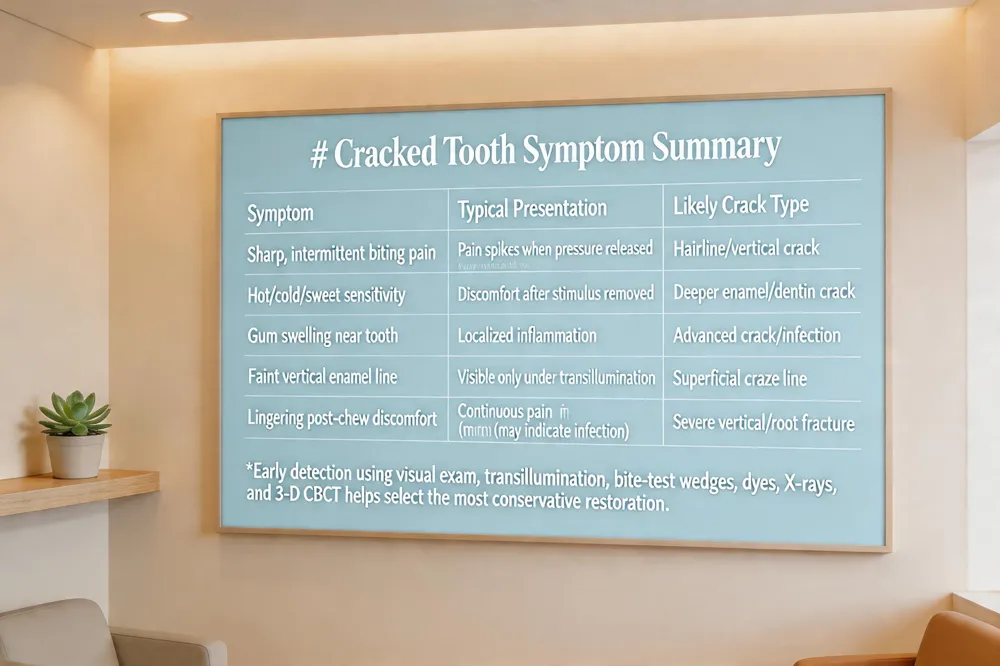 Cracked teeth arise from everyday stressors—hard foods, grinding (bruxism), large fillings, or a sudden impact. The fractures range from tiny craze lines (superficial enamel scratches) to deeper vertical cracks, fractured cusps, split teeth, or even vertical root fractures. Patients typically notice sharp, intermittent pain when they bite down or release pressure, heightened sensitivity to hot, cold, or sweet foods, and occasional gum swelling around the affected tooth. A hairline crack may show a faint vertical line and cause brief, sharp pain that comes and goes, while more extensive cracks produce lingering discomfort and may lead to infection if untreated.
Our office uses a full diagnostic toolkit: a careful visual exam, transillumination lights, bite‑test wedges, staining dyes, digital X‑rays, and 3‑D cone‑beam CT scans to locate the fracture’s depth and direction. Early detection allows us to choose the most conservative restoration—bonding for small cracks, inlays or onlays for moderate damage, and crowns or root‑canal therapy for severe cases. Prompt treatment not only relieves pain but also preserves natural tooth structure and prevents the need for extraction. If you notice any of these symptoms, schedule a check‑up so we can evaluate and protect your smile with the latest, patient‑focused technology.
Minimally Invasive Restorations: Bonding and Inlays
Bonding vs. Inlays/Onlays – Quick Reference
| Restoration | Ideal Indication | Materials | Advantages | Limitations |
|---|---|---|---|---|
| Dental Bonding | Small superficial cracks, chips, front‑tooth aesthetic fixes | Composite resin | Single‑visit, preserves enamel, excellent aesthetics | May chip/stain on high‑stress posterior teeth |
| Inlay | Moderate cracks confined within cusps, no cusp loss | Porcelain, composite, gold | Strong reinforcement, indirect fabrication, preserves more tooth than crown | Requires lab work, may need second visit |
| Onlay | Cracks involving one or more cusps, larger decay, post‑root‑canal | Porcelain, composite, gold | Covers cusp(s) for strength, less tooth reduction than crown | Not suitable for extensively weakened teeth |
When cracks are larger or located on high‑stress teeth, transition from bonding to onlay or crown is recommended.
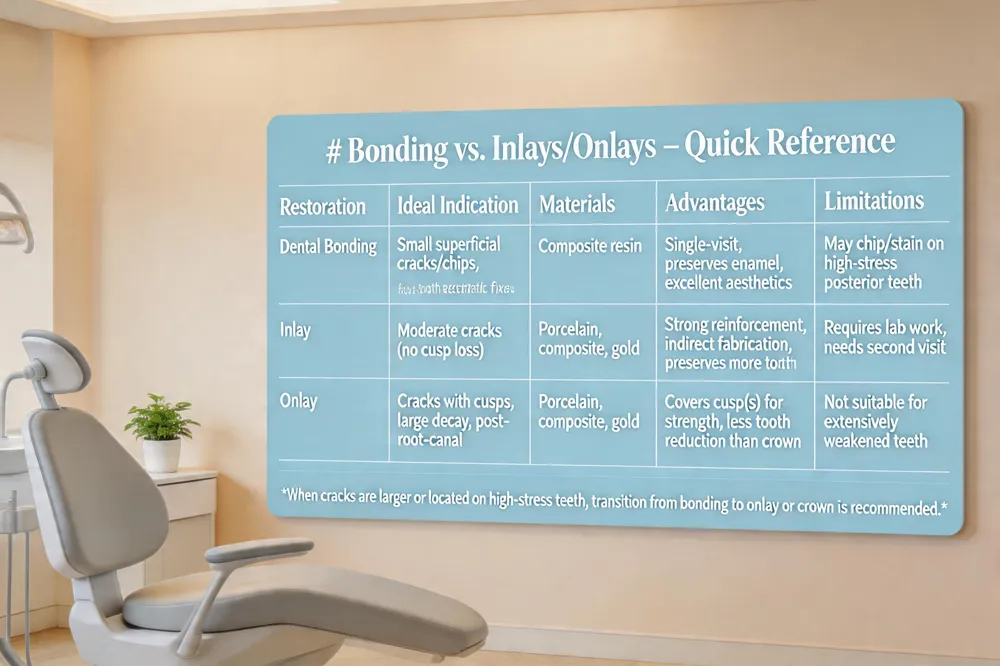 When a tooth has a small crack, chip, or surface imperfection, dental bonding is often the first line of treatment. The tooth‑colored composite resin is etched, sculpted, and cured in a single visit, preserving most of the natural enamel and providing a seamless aesthetic match. Bonding works best for superficial cracks that do not extend deep into dentin or the pulp, and for front‑tooth repairs where chewing forces are lower.
Inlays and onlays are indirect restorations that bridge the gap between a simple filling and a full crown. An inlay fits within the cusps of a tooth, while an onlay (or partial crown) covers one or more cusps, offering stronger reinforcement for moderate‑size cracks that involve the chewing surface. These restorations are custom‑fabricated from porcelain, composite, or gold, and bonded to the tooth for a durable, natural‑looking result.
Limitations of bonding become apparent when cracks are larger, deeper, or located on high‑stress posterior teeth. In such cases the composite may chip, stain, or fail to seal the crack adequately, and an onlay or crown is recommended to distribute biting pressure evenly.
What is considered major restorative dental treatment? Major restorative treatment includes crowns, bridges, implants, inlays/onlays, and full‑arch reconstructions that replace or rebuild extensively damaged teeth.
Onlay vs filling A filling is ideal for small cavities and is placed directly in one visit. An onlay is a lab‑made partial crown used when decay or a crack involves one or more cusps, offering greater strength and preserving more tooth structure than a full crown.
How to fix a cracked tooth naturally Natural healing is not possible because enamel cannot regenerate. Home measures—cold compress, warm salt‑water rinse, clove oil or garlic paste—can calm pain, but prompt professional care is essential for a permanent fix.
What does restorative dental treatment cover? Restorative care repairs damaged teeth (fillings, bonding, inlays/onlays), removes infected pulp (root canal), and replaces lost teeth (crowns, bridges, implants, dentures) to restore function, aesthetics, and oral health.
Partial Coverage Restorations: Onlays
Onlay Pros, Cons, Cost & Longevity
| Aspect | Details |
|---|---|
| Indications | Moderate damage to one/more cusps, large decay, post‑root‑canal with sufficient remaining structure |
| Pros | Preserves more natural enamel/dentin, less tooth reduction, lower cost than crown, excellent aesthetics |
| Cons | Limited to moderate damage, may not withstand extreme functional loads, requires precise bonding technique |
| Cost (USD) | $650 – $1,200 per tooth (average ≈ $900) |
| Longevity | 10 – 15 years with good oral hygiene, regular cleanings, and night‑guard protection |
| Comparison to Crown | Crown costs $1,100 – $1,650, removes more healthy tooth, higher strength for severely compromised teeth |
Onlays are a durable, aesthetic solution for reinforcing cracked cusps while conserving tooth structure.
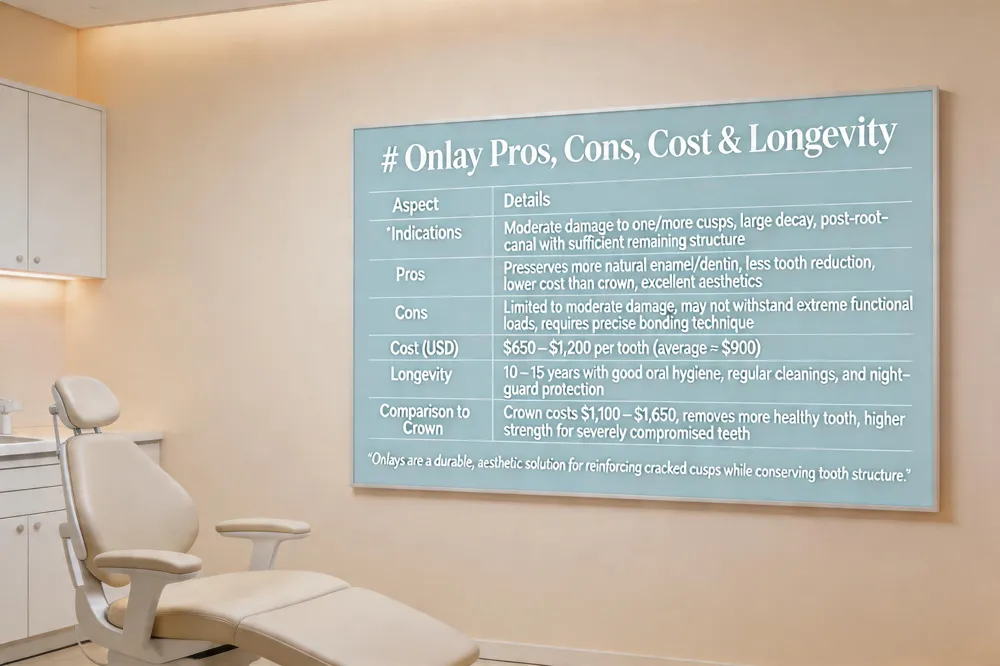 At Best Choice Dental we offer onlays as a conservative, tooth‑preserving alternative to full crowns. Indications for onlays include moderate damage limited to one or more cusps—such as a cracked cusp, a large decay, or a tooth that has undergone a root‑canal but still retains most of its crown. When the remaining structure is strong enough to support a bonded restoration, an onlay is preferred, while full‑coverage crowns are reserved for extensively weakened teeth, multiple cracked cusps, or cases requiring maximal reinforcement.
Pros and cons compared with crowns: Onlays preserve more natural enamel and dentin, require less tooth reduction, and are often less costly. They bond directly to the tooth, offering strong aesthetics and a natural feel. However, they are best suited for limited damage and may not protect teeth with severe decay or high functional loads. Crowns encase the entire tooth, delivering superior strength for heavily compromised teeth, but they remove more healthy tooth, are generally more expensive, and may involve a longer treatment timeline.
Cost and longevity considerations: Onlay fees typically range from $650 to $1,200 per tooth, averaging around $900, while crowns run $1,100 to $1,650. Both restorations can last 10‑15 years with proper oral hygiene, regular cleanings, and protection from grinding (e.g., a night guard). Insurance often covers a portion of each, and financing options are available to keep care affordable.
Can you put an onlay on a cracked tooth? Absolutely—onlays effectively seal and reinforce cracked cusps, preserving the tooth’s appearance and function while offering a durable, aesthetic solution.
Full Coverage Restorations: Crowns and When They’re Needed
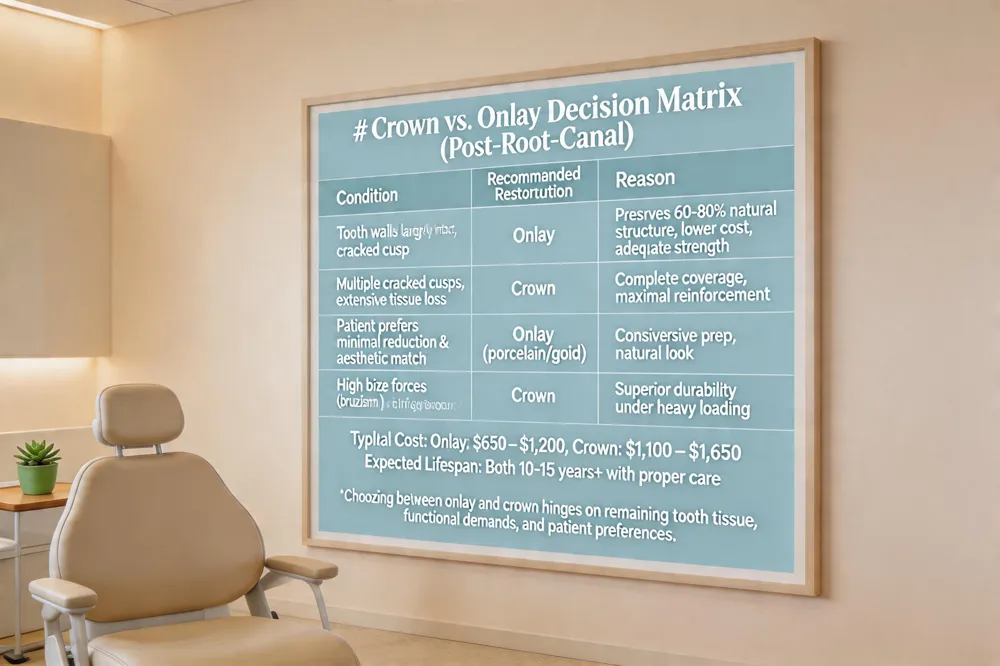
Crown vs. Onlay Decision Matrix (Post‑Root‑Canal)
| Condition | Recommended Restoration | Reason |
|---|---|---|
| Tooth walls largely intact, single cracked cusp | Onlay | Preserves 60‑80 % natural structure, lower cost, adequate strength |
| Multiple cracked cusps, extensive tissue loss, need for full shape | Crown | Provides complete coverage, maximal reinforcement |
| Patient prefers minimal reduction & aesthetic match | Onlay (porcelain or gold) | Conservative prep, natural look |
| High bite forces (bruxism) or large bridge support | Crown | Superior durability under heavy loading |
| Typical Cost | Onlay: $650 – $1,200; Crown: $1,100 – $1,650 | |
| Expected Lifespan | Both 10‑15 years+ with proper care |
Choosing between onlay and crown hinges on the amount of remaining tooth tissue, functional demands, and patient preferences.
 A dental crown is the go‑to solution when a cracked tooth is severely weakened, has large existing fillings, or has undergone a root‑canal procedure. By encasing the entire visible portion of the tooth, a crown distributes chewing forces evenly, protects the remaining structure, and restores a natural shape and color.
Root‑canal restoration – After a root‑canal, the tooth walls are often thin and brittle. If most of the original tooth is still intact, an onlay can preserve 60‑80 % of the natural structure while reinforcing the damaged cusp. When the tooth has lost extensive tissue, multiple cracked cusps, or the patient prefers a completely reshaped appearance, a full crown provides the most comprehensive protection.
Dental onlay vs crown – An onlay is a partial‑coverage restoration that fits over the damaged cusps, conserving healthy enamel and requiring less tooth reduction. A crown is a full‑coverage cap that removes more healthy tooth but offers maximal strength for heavily damaged teeth. Both can be made from porcelain or other tooth‑colored materials for a natural look; the choice depends on crack size, bite forces, and aesthetic goals.
Onlay vs crown after root canal – If the tooth’s walls are largely intact, an onlay preserves more natural tissue and costs a bit less. A crown is preferred when multiple surfaces are compromised or a completely new tooth shape is needed. Both restorations can last 10‑15 years with proper oral hygiene.
Major restorative dental care – This encompasses extensive procedures such as crowns, bridges, dentures, and implants that repair or replace severely damaged teeth. At Best Choice Dental in Totowa, we use modern materials and techniques to deliver durable, natural‑looking results while preserving as much healthy tooth as possible.
Restorative dentistry meaning – Restorative dentistry repairs damaged or missing teeth to restore function, health, and aesthetics, emphasizing preservation of natural tooth structure whenever feasible.
Finding Restorative Care Near You and Preventing Future Cracks
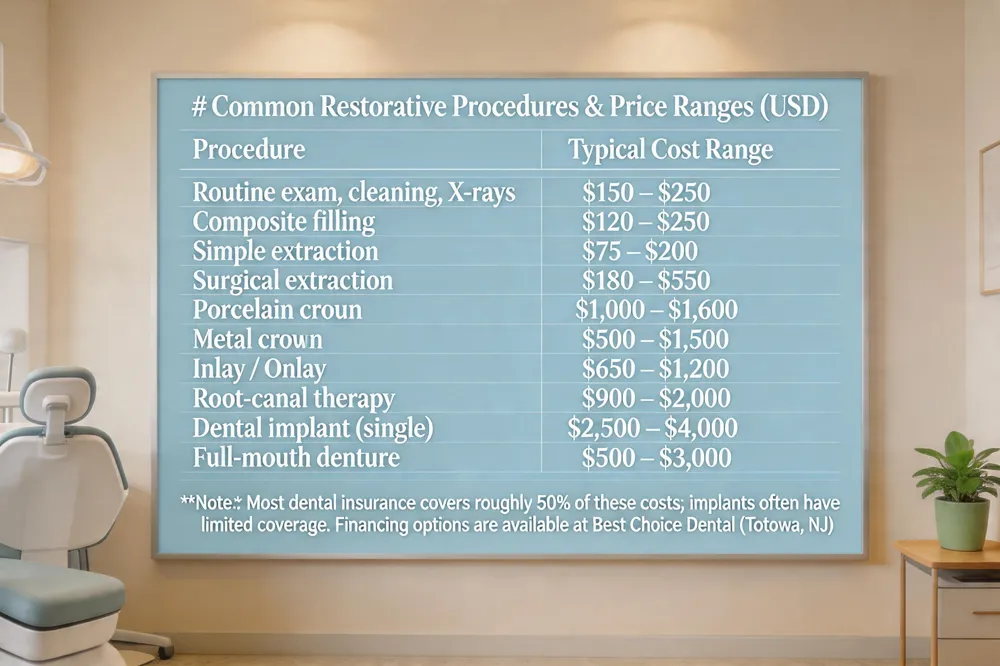
Common Restorative Procedures & Price Ranges (USD)
| Procedure | Typical Cost Range |
|---|---|
| Routine exam, cleaning, X‑rays | $150 – $250 |
| Composite filling | $120 – $250 |
| Simple extraction | $75 – $200 |
| Surgical extraction | $180 – $550 |
| Porcelain crown | $1,000 – $1,600 |
| Metal crown | $500 – $1,500 |
| Inlay / Onlay | $650 – $1,200 |
| Root‑canal therapy | $900 – $2,000 |
| Dental implant (single) | $2,500 – $4,000 |
| Full‑mouth denture | $500 – $3,000 |
Note: Most dental insurance covers roughly 50 % of these costs; implants often have limited coverage. Financing options are available at Best Choice Dental (Totowa, NJ).
 Restorative dentistry near me – If you’re searching for restorative dentistry near you in Totowa, New Jersey, Best Choice Dental provides a comprehensive suite of treatments to bring damaged or missing teeth back to health and confidence. Our family‑oriented practice, led by Dr. Pamela Casperino and Dr. Victor Salvador, offers dental bonding, porcelain crowns, veneers, implant restorations, bridges, specialty dentures/partials, inlays/onlays, root‑canal therapy, extractions and custom night guards—all performed with modern, minimally invasive techniques. Conveniently located at 547 Union Blvd., Totowa, NJ 07512, we’re just a short drive from Clifton, Wayne and Woodland Park. Call (973) 942‑3233 today to schedule an appointment and restore your smile with confidence.
Restorative dentistry cost – In the United States, simple fillings range from $100–$250, while a porcelain crown costs $1,000–$1,600. Root‑canal therapy runs $900–$2,000, and implants fall between $2,500–$3,500 per tooth. Most dental insurance plans cover roughly half of these expenses, though implants may receive limited coverage.
List of dental procedures and prices – Routine exams with cleaning and X‑rays are $150–$250. Composite fillings $120–$250, extractions $75–$200 (simple) or $180–$550 (surgical). Crowns $500–$1,500 (metal) to $1,200–$2,500 (porcelain‑fused‑to‑metal). Root canals $900–$1,300, implants $2,500–$4,000, and full‑mouth dentures $500–$3,000, depending on materials.
How to fix a cracked tooth without going to the dentist – Rinse gently with warm salt water, seal the crack with dental wax or temporary filling material, take ibuprofen for pain, apply a cold compress, and avoid hard, sticky, hot, or cold foods. Schedule a dental visit promptly.
Tooth cracked in half no pain – A painless split often means the crack is limited to enamel or the nerve is already non‑responsive. Bacteria can still infiltrate, leading to infection or loss. Seek emergency care, avoid chewing on that side, and keep the area clean until you can be evaluated.
Putting It All Together
When a tooth cracks, the first step is a thorough evaluation—visual exam, bite tests, and imaging—to determine the depth and location of the fracture. Small enamel‑only cracks or craze lines are best treated with minimally invasive dental bonding, which seals the crack and preserves most of the natural tooth. If the crack involves a cusp or moderate dentin loss, an onlay (partial crown) offers stronger reinforcement while still conserving healthy structure. For extensive fractures, multiple weakened cusps, or teeth that have undergone root‑canal therapy, a full‑coverage crown provides the most durable protection. Early detection and prompt treatment are crucial; they halt crack propagation, reduce infection risk, and keep restorative options conservative, ensuring a healthier smile with fewer appointments and lower long‑term costs.