Introduction
Digital dentistry is reshaping how families receive restorative care. At our practice we capture a precise 3‑D model of your teeth with an intra‑oral scanner, eliminating messy impression trays and the gag reflex. That digital impression feeds directly into CEREC’s CAD/CAM workflow, allowing our team to design, mill, and place a custom ceramic crown in a single visit—often within 60‑90 minutes. This efficient, same‑day approach reduces the need for temporary crowns, cuts down on appointments, and delivers a natural‑looking, durable restoration that fits as accurately as a lab‑fabricated crown. By combining cutting‑edge technology with personalized, comfortable care, we help you restore function and smile confidence quickly and conveniently.
Understanding Digital Impressions
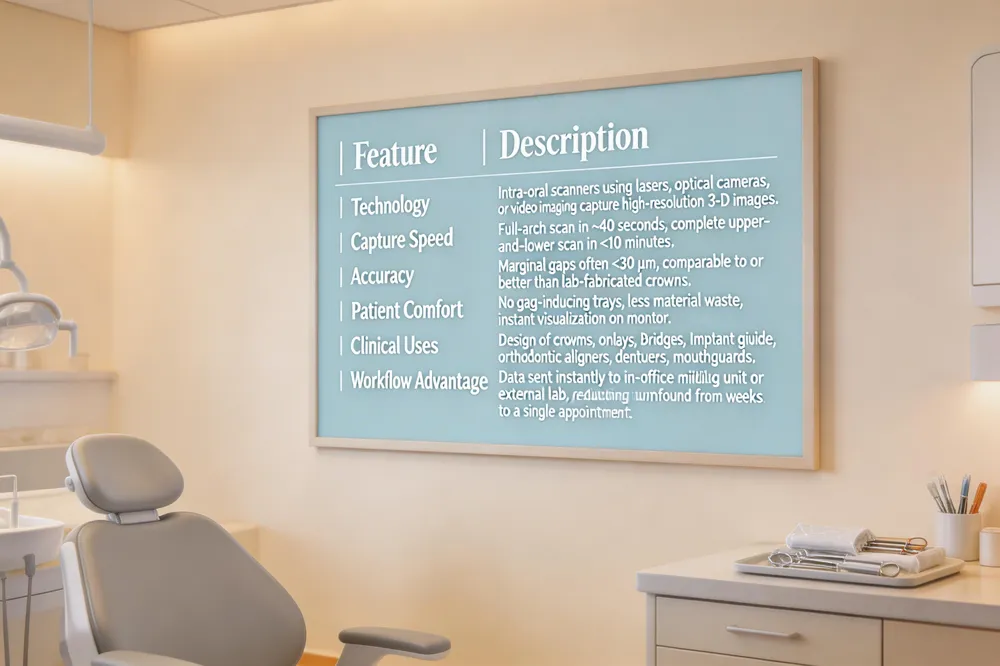
| Feature | Description |
|---|---|
| Technology | Intra‑oral scanners using lasers, optical cameras, or video imaging capture high‑resolution 3‑D images. |
| Capture Speed | Full‑arch scan in ~40 seconds; complete upper‑and‑lower scan in <10 minutes. |
| Accuracy | Marginal gaps often <30 µm, comparable to or better than lab‑fabricated crowns. |
| Patient Comfort | No gag‑inducing trays, less material waste, instant visualization on monitor. |
| Clinical Uses | Design of crowns, onlays, bridges, implant guides, orthodontic aligners, dentures, mouthguards. |
| Workflow Advantage | Data sent instantly to in‑office milling unit or external lab, reducing turnaround from weeks to a single appointment. |
 Digital impressions are computer‑generated, three‑dimensional scans of a patient’s teeth and surrounding oral tissues created with intra‑oral scanners that use lasers, optical cameras, or video imaging. The scanner captures a rapid series of high‑resolution images or video, which the software stitches together into an accurate digital map of the mouth. This virtual model replaces traditional messy impression trays and can be viewed instantly on a chair‑side monitor.
Intra‑oral scanners work by moving a small wand across the prepared tooth and adjacent teeth. As the wand sweeps, it records thousands of points per second, building a polygonal model that represents the exact shape, contour, and bite relationship of the arch. A full‑arch scan can be completed in as little as 40 seconds for an experienced operator, and most patients finish the upper‑and‑lower scan in under ten minutes.
Clinically, digital impressions offer several advantages over conventional putty or alginate impressions. They eliminate the gag‑inducing trays, reduce material waste, and provide higher accuracy—studies show marginal gaps often under 30 µm, comparable to or better than lab‑fabricated crowns. The immediate 3‑D visualization aids communication, allowing patients to see their own anatomy on a screen and understand the proposed restoration.
In restorative dentistry, the digital model is the foundation for designing crowns, onlays, bridges, and same‑day CEREC prostheses. It also guides implant surgical guides, orthodontic aligners, dentures, and custom mouthguards. Because the data are electronic, they can be sent instantly to an in‑office milling unit or an external laboratory, shortening turnaround time from weeks to a single appointment.
Overall, digital impressions improve comfort, precision, and efficiency, making crown placement and other restorations faster, more predictable, and patient‑friendly.
The CEREC Workflow: From Scan to Crown
| Step | Action | Approx. Time |
|---|---|---|
| 1 | Tooth preparation & intra‑oral scan | <1 minute per arch |
| 2 | CAD design (margin, shade, occlusion) | 5‑10 minutes |
| 3 | Milling of crown (lithium disilicate or zirconia) | 15‑20 minutes |
| 4 | Polishing, staining, optional glazing | 5‑10 minutes |
| 5 | Try‑in, adjustment, cementation | 5‑10 minutes |
| Total | Same‑day restoration | ≈60‑90 minutes |
| Fit Accuracy | Marginal fit 20‑100 µm | — |
| Cost (US) | $500‑$1,500 per tooth (NJ typical $900‑$1,200) | — |
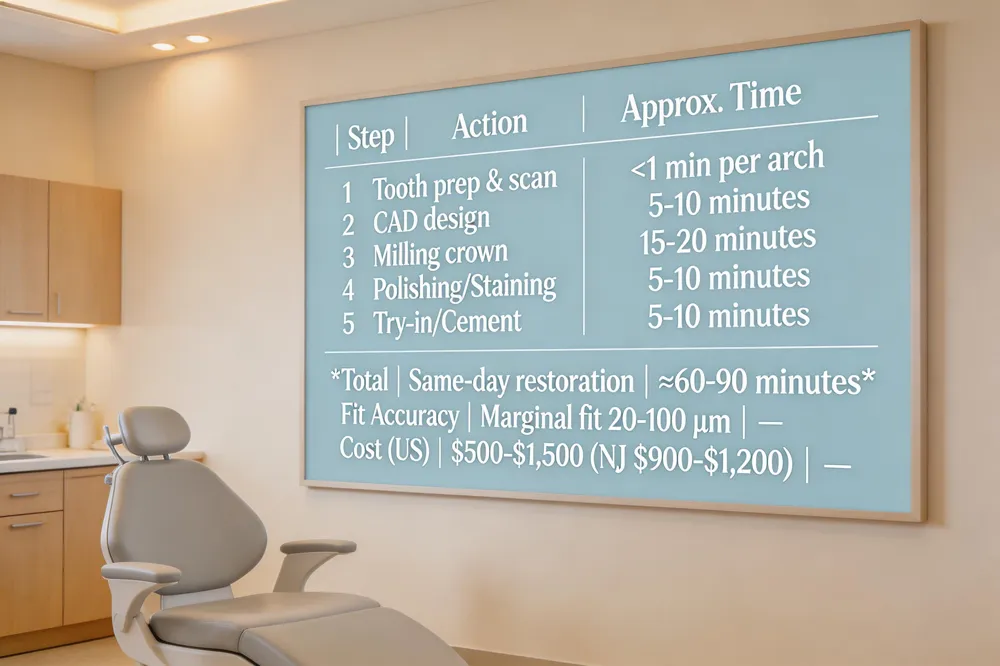 CEREC (Chairside Economical Restoration of Esthetic Ceramics) combines a digital scanner, CAD design software, and an in‑office milling unit to create a permanent ceramic crown in a single visit. First, the dentist prepares the tooth and uses an intra‑oral scanner to capture a painless 3‑D digital impression—no messy trays, no gag reflex. The scan is instantly sent to CEREC software, where the dentist adjusts the margins, shade and occlusion, and visualizes the final restoration on a monitor. Next, the design is sent to the milling machine, which carves the crown from a solid block of high‑strength lithium disilicate or zirconia in about 15‑20 minutes. After polishing, staining, and optional glazing, the crown is tried in, adjusted for a perfect bite, and permanently cemented. This workflow delivers a marginal fit within 20‑100 µm, comparable to laboratory‑fabricated crowns, and eliminates the need for a temporary crown.
Cost considerations – In the United States a CEREC crown typically ranges from $500 to $1,500 per tooth. New Jersey practices often price them around $900 to $1,200, reflecting the convenience of same‑day service and the use of premium ceramic materials. Insurance may cover part of the fee; check your plan for exact reimbursement.
Hardest tooth to prepare – Lower molars are usually the most challenging because of their large size, multiple cusps, and limited back, making precise reduction and bonding more demanding.
The “3‑3‑3 rule” – This informal guideline (brush three times a day, three minutes each, and avoid eating three hours before sleep) is not evidence‑based. Dental professionals recommend brushing twice daily for two minutes, daily flossing, and regular check‑ups for optimal oral health.
Patient Experience and Benefits of Same‑Day Crowns
| Benefit | Details |
|---|---|
| Comfort | No messy trays, no gag reflex, quick 3‑D scan. |
| Time Savings | One appointment replaces typically three visits (scan, temporary, final). |
| Immediate Results | Permanent crown placed in under two hours; no temporary crown needed. |
| Communication | 3‑D visualization helps patients understand anatomy, shade, and shape. |
| Durability | High‑strength lithium disilicate or zirconia crowns last ≥10 years with proper care. |
| Oral Health | Precise fit reduces gaps, lowering risk of secondary decay. |
| Family Convenience | Coordinated scheduling for multiple family members in a single visit. |
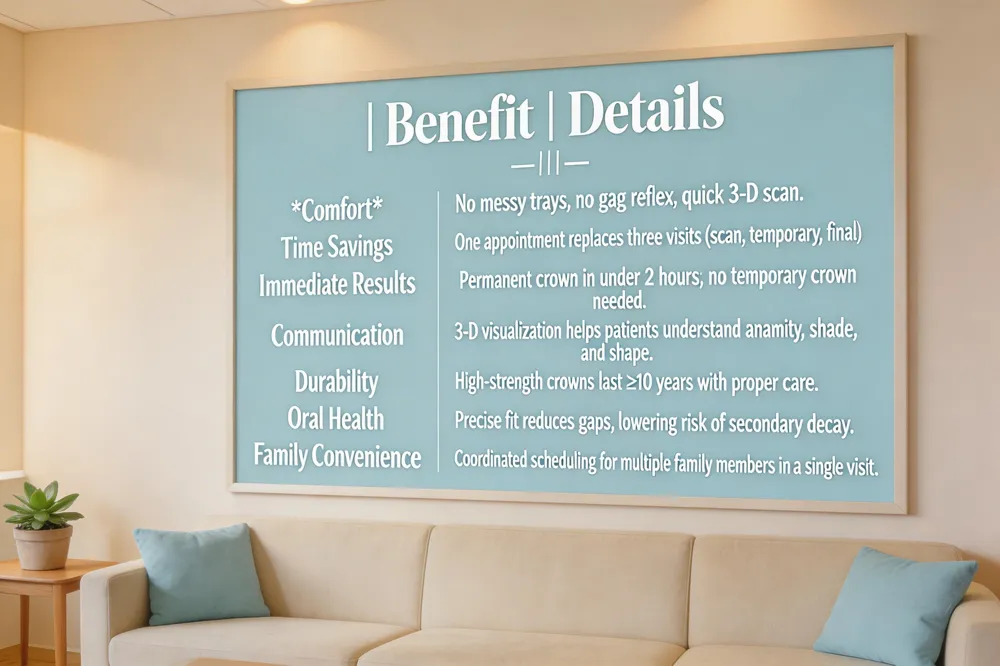 A family dental practice is a one‑stop clinic that provides preventive, restorative, cosmetic, and specialized oral‑health services for every member of a household, from infants to seniors. It employs a team of dentists and hygienists who can treat all ages under one roof, offering flexible, coordinated scheduling so multiple family members can be seen in the same visit. Family dentistry is a subset of general dentistry—both share the same core procedures—but family dentists focus on age‑inclusive care, simplifying appointments and record‑keeping for the whole household.
When it comes to same‑day crowns, digital scanning offers major comfort advantages. An intra‑oral scanner captures a precise 3‑D image in seconds, eliminating messy trays, gag‑inducing materials, and the unpleasant taste of traditional impressions. The scan is instantly visualized on a monitor, allowing the dentist to show the patient a realistic model of the tooth and discuss shade and shape before milling. Because the crown is designed and milled on‑site, a temporary crown is unnecessary, and the entire workflow—scan, CAD design, CAM milling, polishing, and cementation—can be completed in under two hours. This reduces the number of appointments from three to one, saving time and minimizing disruption to busy families.
CEREC‑fabricated crowns made from high‑strength lithium disilicate or zirconia, provide long‑term durability comparable to laboratory‑crafted restorations, often lasting a decade or more with proper oral hygiene. The precise digital fit improves oral health by reducing gaps that can harbor bacteria, lowering the risk of secondary decay. Patients appreciate the immediate, permanent restoration and the clear communication enabled by 3‑D visualizations, which enhance confidence and satisfaction with their care.
Dentists may treat family members, but many follow ADA guidelines to maintain professional boundaries, ensuring informed consent, thorough documentation, and unbiased recommendations. When needed, specialists are consulted to provide the highest quality of care for every family member.
Practical Considerations for Totowa Families
| Consideration | Information |
|---|---|
| Practice | Best Choice Dental – one‑stop family dental home in Totowa. |
| Workflow Time | Same‑day crown process typically 60‑90 minutes. |
| Post‑Placement Care | Brush twice daily with soft brush, floss daily, professional cleaning every 6 months. |
| Insurance & Financing | Works with most plans; flexible financing options available. |
| Scheduling | Multiple family members can be seen in one visit, reducing time off work/school. |
| Technology | In‑office intra‑oral scanner + CEREC CAD/CAM system. |
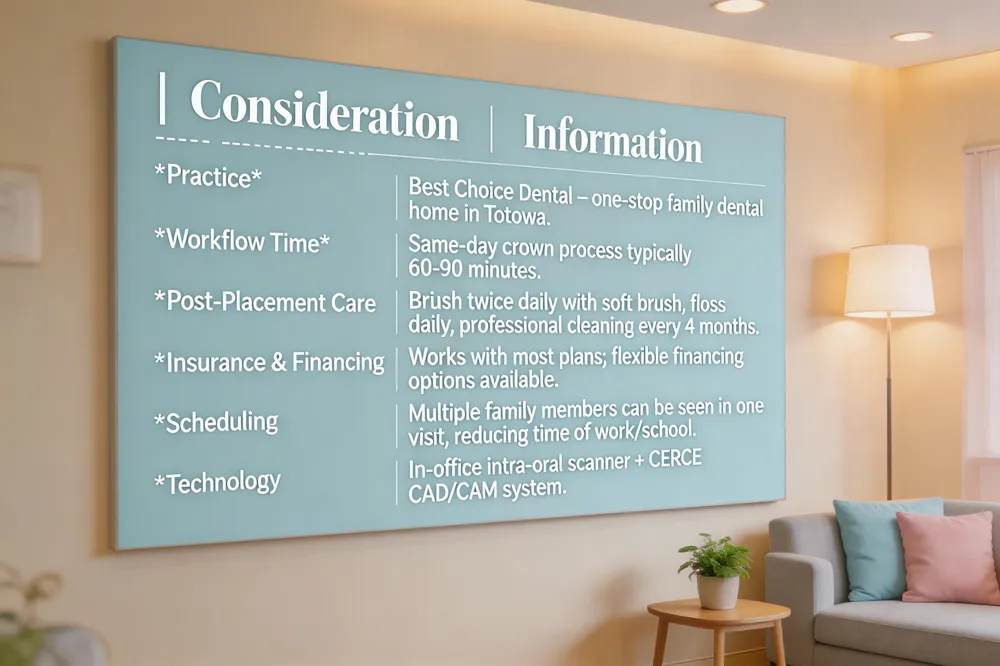 Choosing a family dental practice means you can count on a one‑stop clinic that meets the preventive, restorative, cosmetic and specialized oral‑health needs of every household member—from infants to seniors. At Best Choice Dental in Totowa, the team of dentists and hygienists coordinates care so parents can schedule multiple family members in a single visit, reducing time away from work or school.
The practice’s digital workflow begins with an intra‑oral scanner that captures a precise 3‑D impression in seconds, eliminating the mess and discomfort of traditional putty trays. The scan is instantly imported into CEREC CAD software, where the dentist designs a custom crown that is milled on‑site. This same‑day crown process typically takes 60‑90 minutes, allowing busy families to leave with a permanent, aesthetically matched restoration in one appointment—no temporary crown, no multiple trips.
After placement, patients receive clear oral‑hygiene recommendations: brush twice daily with a soft‑bristled brush, floss daily, and schedule professional cleanings every six months to protect the new crown and maintain overall gum health.
Best Choice Dental works with most dental insurance plans and offers flexible financing options, making the advanced CEREC technology affordable for families. The practice’s commitment to modern technology, personalized comfort and transparent payment solutions ensures that Totowa families receive high‑quality, convenient dental care.
Future Trends and Advanced Technologies
| Trend | Description |
|---|---|
| AI‑Assisted Design | Automatic suggestions for crown thickness, occlusal contacts, and shade matching. |
| Chair‑Side 3‑D Printing | On‑demand provisional restorations and custom aligner trays. |
| Expanded Applications | Direct workflow for implant surgical guides and clear‑aligner therapy. |
| Sustainability | Digital impressions eliminate stone casts and shipping, reducing waste and carbon footprint. |
| Patient Personalization | Faster, greener, and more tailored dental experiences across all ages. |
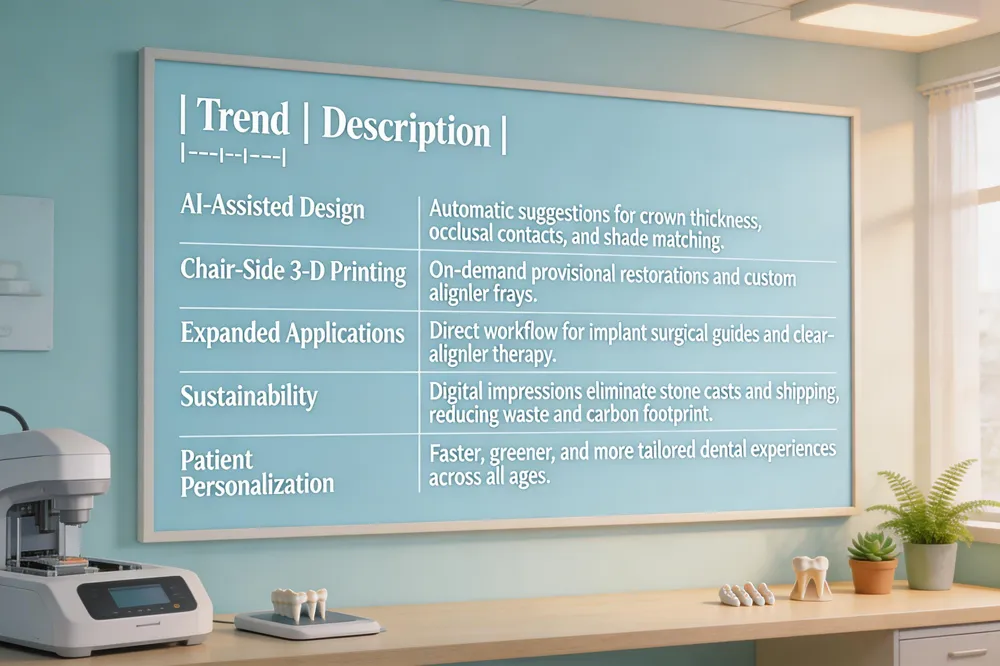 Dental practices that already use CEREC are looking ahead to the next wave of digital innovation. The newest CEREC software now includes AI‑assisted design suggestions that automatically propose optimal crown thickness, occlusal contacts and shade matches, letting the dentist fine‑tune a restoration in seconds while preserving a natural look. At the same time, many offices are adding chair‑side 3‑D printers to produce provisional restorations on demand, so patients can see a temporary tooth that fits perfectly before the final ceramic crown is milled.
Beyond crowns, the digital workflow is expanding to implant guides and clear‑aligner therapy: intra‑oral scans feed directly into implant‑planning software (e.g., Dentsply Sirona’s mySimplant) and into orthodontic modules that generate custom aligner trays, all without sending physical models to a lab. These advances also support sustainability—digital impressions eliminate messy trays and impression material, and on‑site milling or printing removes the need for shipping stone casts, cutting waste and carbon footprint while keeping costs lower for families.
Together, AI‑driven design, in‑office 3‑D printing, and broader restorative and orthodontic applications are shaping a faster, greener, and more personalized dental experience for patients of all ages.
Conclusion
Digital impressions captured with an intra‑oral scanner give a precise, 3‑D model of the tooth in seconds, eliminating the messy trays and discomfort of traditional molds. The seamless CAD/CAM workflow of CEREC then designs, mills, and shades a high‑strength ceramic crown in the office, delivering a perfect fit, natural shade, and permanent restoration in a single visit. This same‑day solution means no temporary crowns, fewer appointments, and faster return to normal eating and speaking. At Best Choice Dental in Totowa, NJ, our family‑focused team combines this cutting‑edge technology with gentle, personalized care. Call us today to schedule your same‑day CEREC crown and experience the comfort and convenience modern digital dentistry offers.