Introduction
Effective communication is the foundation of quality dental care, especially for patients who speak Spanish or other languages at home. When a dentist speaks the patient’s language, explanations of procedures, preventive advice, and after‑care instructions become clear, reducing anxiety and improving treatment outcomes. Cultural competence—understanding values, beliefs, and communication styles—further builds trust and satisfaction, as shown by the American Dental Association’s research on patient‑dentist relationships. Family‑oriented practices such as Grace Dental Smiles, True Dental Care, and NÜVA Smile integrate bilingual staff, flexible scheduling, and comprehensive services—from preventive cleanings to cosmetic smile make—to meet the diverse needs of every age group. This personalized, comfortable approach ensures that every patient feels respected, heard, and confident in their oral‑health journey throughout each visit.
Why Language and Cultural Competence Matter in Dental Care
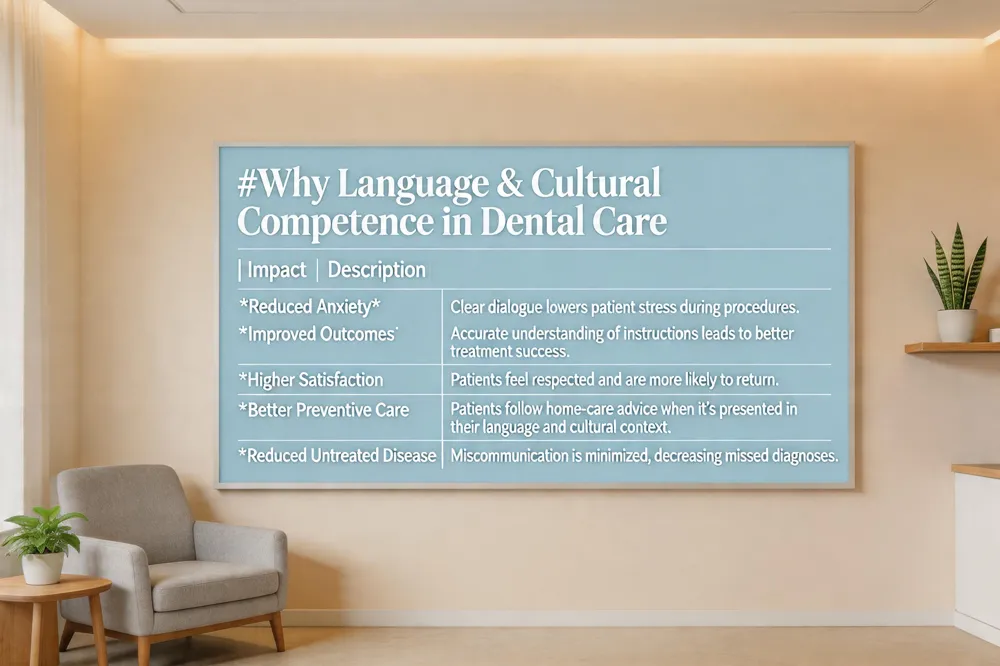
#Why Language & Cultural Competence in Dental Care
| Impact | Description |
|---|---|
| Reduced Anxiety | Clear dialogue lowers patient stress during procedures. |
| Improved Outcomes | Accurate understanding of instructions leads to better treatment success. |
| Higher Satisfaction | Patients feel respected and are more likely to return. |
| Better Preventive Care | Patients follow home‑care advice when it’s presented in their language and cultural context. |
| Reduced Untreated Disease | Miscommunication is minimized, decreasing missed diagnoses. |
 Effective communication is a cornerstone of oral health. The American Dental Association reports that clear dentist‑patient dialogue reduces anxiety, improves treatment outcomes, and boosts satisfaction. When language barriers exist, patients may misinterpret instructions, skip preventive care, and experience delayed treatment—factors that contribute to higher rates of untreated disease among non‑English speakers. In the United States, 21 % of households speak a language other than English, with Spanish being the most common; practices that employ bilingual staff, such as Grace Dental Smiles, see higher patient retention and better adherence to care plans.
Cultural diversity among dental hygienists enhances this effect. Hygienists who understand patients’ cultural beliefs, dietary habits, and health‑literacy levels can tailor preventive advice, use visual aids, and employ teach‑back methods to ensure comprehension. Ongoing cultural‑competency training for hygienists leads to more trust and lower anxiety, especially in multicultural communities.
Guidelines for routine visits recommend a dental check‑up every six months; the “2‑year rule” is a maximum interval, not an optimal schedule. Regular visits allow early detection of cavities and gum disease, reducing long‑term costs.
Free cultural‑competency CE is available through the U.S. Department of Health & Human Services’ online program, offering six ADA‑approved credits at no cost. This resource helps dental teams meet continuing‑education requirements while delivering equitable, culturally sensitive care.
Finding Bilingual Family Dentists Near You
Bilingual Family Dentists in Totowa, NJ
| Practice | Address | Phone | Languages Offered | Notable Services |
|---|---|---|---|---|
| Best Choice Dental | 418 Union Blvd, Totowa, NJ 07512 | (973) 595‑5955 | Spanish | Preventive, restorative, cosmetic, emergency; digital X‑rays, CBCT |
| Dental Arts of Totowa | 547 Union Blvd, Totowa, NJ 07512 | (973) 942‑3233 | Spanish | Full‑service care including Invisalign, implants, Botox |
| NÜVA Smile – Totowa | 195 Route 46 West, Totowa, NJ 07512 | (973) XXX‑XXXX | Spanish, Russian, Ukrainian, Arabic, Polish | Preventive, restorative, cosmetic; extended hours, 24/7 emergency |
Tip: Use search terms like “bilingual family dentist” + city/ZIP, check staff bios for language icons, read reviews for cultural sensitivity, and call ahead to confirm language support.
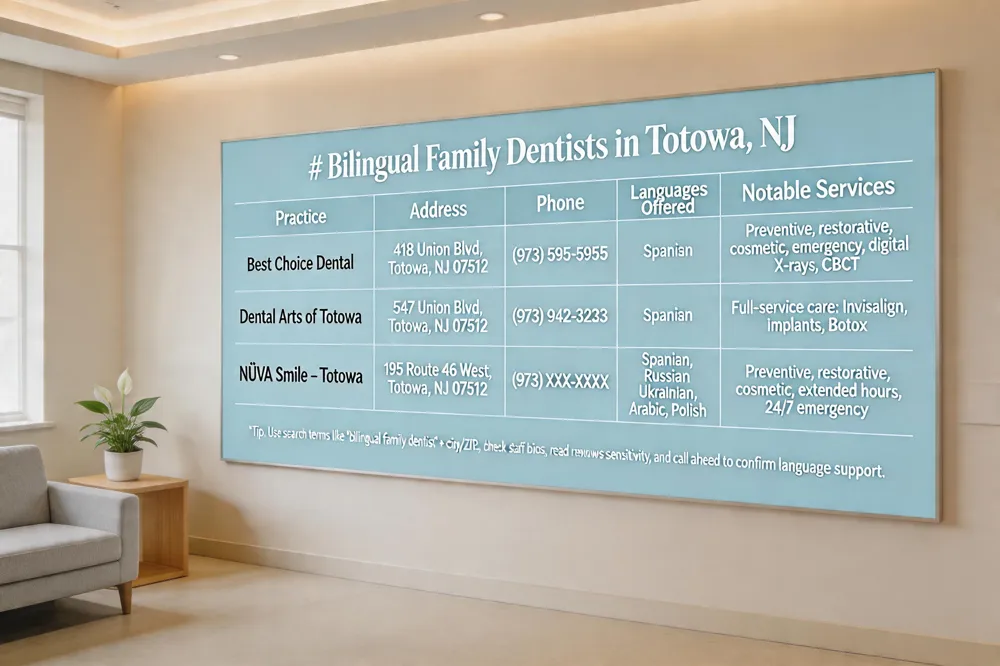 When you need a dentist who speaks your language, start by looking for practices that advertise bilingual staff. Many offices in New Jersey and the surrounding region list Spanish‑speaking clinicians on their websites, and the American Dental Association notes that clear communication improves outcomes and reduces anxiety.
Local Totowa Options
- Best Choice Dental – Totowa, NJ – 418 Union Blvd, Totowa, NJ 07512. Phone (973) 595‑5955. Led by Dr. Richard Gryzmolowicz, DDS, the practice offers preventive, restorative, cosmetic and emergency services using digital X‑rays and cone‑beam imaging. Family‑focused, flexible scheduling and a friendly staff make it a top choice.
- Dental Arts of Totowa – 547 Union Blvd, Totowa, NJ 07512. Phone (973) 942‑3233. Dr. Zoya Mitelberg, DDS provides full‑service care—including Invisalign, implants, and Botox— with state‑of‑the‑art digital imaging and a warm, welcoming environment.
- NÜVA Smile – Totowa – 195 Route 46 West, Totowa, NJ 07512. Multilingual team (Spanish, Russian, Ukrainian, Arabic, Polish) offers preventive, restorative, and cosmetic dentistry, extended hours, and 24/7 emergency support.
Neighborhood‑Wide Search Tips
- Use search terms like "bilingual family dentist" family "Spanish‑speaking dentist" plus your city or ZIP code.
- Check office websites for language icons or staff bios that list Spanish proficiency.
- Read patient reviews for comments on cultural sensitivity and communication.
- Call ahead to confirm language support and ask about translated forms or interpreter services.
These strategies, along with the highlighted practices, will help you find a culturally competent dentist who makes you feel comfortable and understood.
Cultural Sensitivity in Everyday Practice
4 C’s Framework for Cultural Sensitivity
| C | What It Means | Practical Example |
|---|---|---|
| Curiosity | Learn about each patient’s background, beliefs, and preferences. | Ask open‑ended questions about diet and oral‑health traditions. |
| Comfort | Create a welcoming, respectful environment. | Use multilingual signage and culturally appropriate décor. |
| Clarity | Communicate in plain language, use visual aids, confirm understanding. | Employ teach‑back method and illustrated handouts. |
| Confidence | Apply cultural knowledge with humility and professionalism. | Adapt oral‑health advice to align with traditional meals while emphasizing evidence‑based practices. |
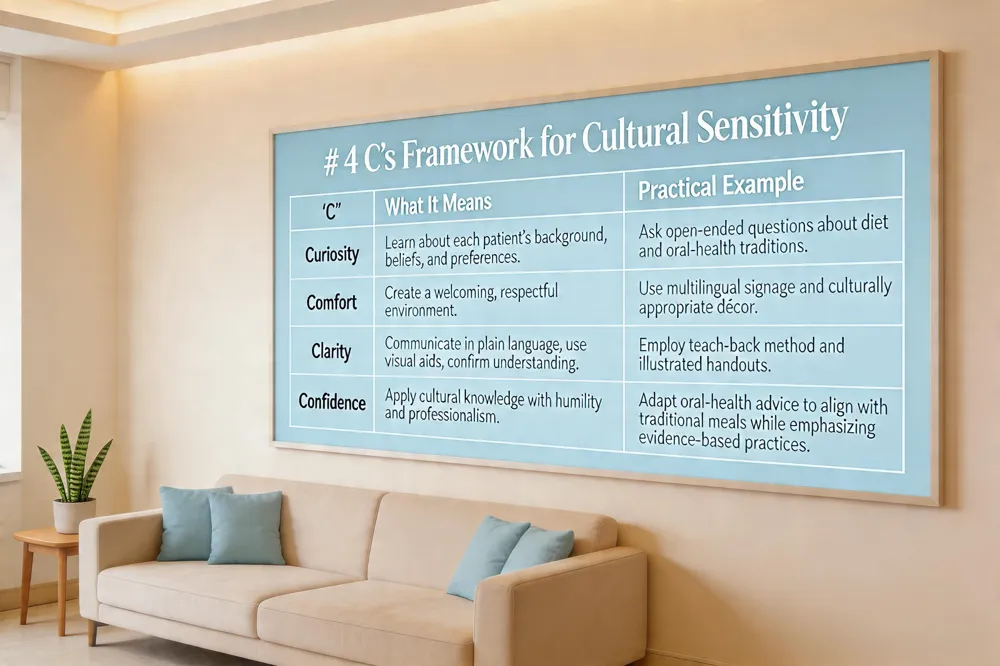 Cultural values shape oral‑health habits by influencing how often patients seek check‑ups, what daily hygiene routines they follow, and which traditional practices they use. In communities where preventive care is prized, regular brushing, flossing and routine dentist visits become the norm; elsewhere, dental care may be viewed as optional or feared, resulting in lower utilization. Traditional methods such as chewing sticks or herbal rinses can aid plaque removal, yet reliance on them without professional care can leave gaps, while cultural celebrations that feature high‑sugar foods or betel‑nut use raise decay risk. Recognizing these beliefs allows dental teams to tailor guidance that respects patients’ customs and promotes healthier habits.
The 4 C’s framework—Curiosity, Comfort, Clarity, and Confidence—offers a practical roadmap. Curiosity drives staff to learn about each patient’s background; Comfort creates a welcoming, respectful environment; Clarity ensures communication is jargon‑free and understood; Confidence lets providers apply cultural knowledge with humility.
A concrete example of cultural sensitivity is a bilingual dentist who explains oral‑health recommendations in Spanish, adapts dietary advice to honor traditional meals, and offers visual aids for patients with limited English proficiency. This approach reduces anxiety, improves treatment adherence, and builds trust, leading to better outcomes for diverse families.
Cost, Coverage, and Building Cultural Competence
Cost & Coverage Benefits of Culturally Competent Family Dentistry
| Aspect | Benefit |
|---|---|
| Bundled Services | One practice provides preventive, restorative, and cosmetic care → lower overall fees. |
| Insurance Acceptance | Practices like Best Choice Dental accept a wide range of plans, including NJ Family Care (covers root canals). |
| Flexible Payment | Discounted bundles, payment plans, and reduced travel costs. |
| Cultural‑Competency Training | Improves patient trust → higher adherence → fewer costly complications. |
| Community Outreach | Builds relationships, leading to early detection and lower treatment costs. |
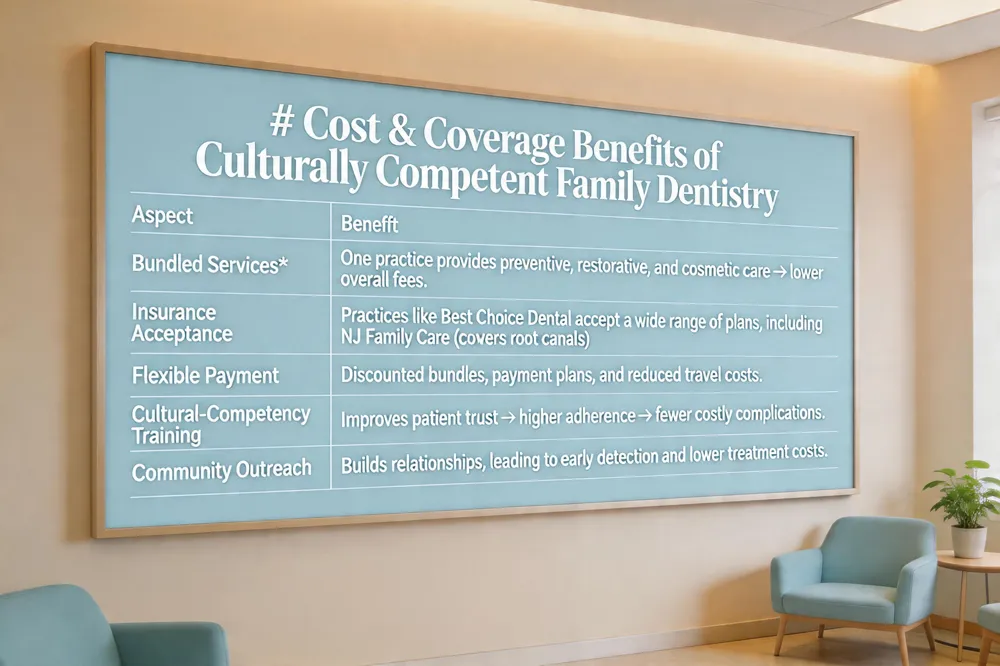 Are family dentists more expensive?
Family dentists are generally more cost‑effective than seeing multiple specialists. Because they deliver preventive, restorative, and cosmetic services under one roof, families avoid extra appointment fees, travel costs, and fragmented records. Practices such as Best Choice Dental in Totowa offer bundled discounts, flexible payment plans, and accept a wide range of insurance plans, which further reduce out‑of‑pocket expenses. While individual procedures may cost similar to a specialist’s, the overall savings from consolidated care and a strong preventive focus make family dentistry usually cheaper in the long run.
Are family dentists more expensive?
Family dentists are generally more cost‑effective than seeing multiple specialists. Because they deliver preventive, restorative, and cosmetic services under one roof, families avoid extra appointment fees, travel costs, and fragmented records. Practices such as Best Choice Dental in Totowa offer bundled discounts, flexible payment plans, and accept a wide range of insurance plans, which further reduce out‑of‑pocket expenses. While individual procedures may cost similar to a specialist’s, the overall savings from consolidated care and a strong preventive focus make family dentistry usually cheaper in the long run.
Propose ways the dental office can start the process to become culturally competent
- Conduct a practice‑wide cultural assessment to spot gaps in language access, signage, and patient communication.
- Provide staff with cultural‑competency training that includes role‑playing diverse patient scenarios and teaches the LEARN and teach‑back methods.
- Update intake forms, consent documents, and educational materials to be multilingual (e.g., Spanish, Chinese, Russian) and culturally relevant.
- Establish easy feedback channels—online forms, QR‑coded cards—and review responses regularly.
- Engage the local community through outreach events, health fairs, and partnerships with cultural organizations to build genuine relationships.
Does NJ Family Care cover root canals? Yes. NJ Family Care includes root canal therapy among its covered dental services.
Which culture has the healthiest teeth? Denmark is often cited as having some of the healthiest teeth worldwide, thanks to widespread oral‑hygiene habits and a robust dental health system.
Do dental offices have to provide interpreters? Under the Americans with Disabilities Act, dental offices are public accommodations and must provide auxiliary aids—such as sign‑language interpreters or other communication assistance—unless doing so would cause an undue burden.
Patient Voices: Reviews and Real‑World Experiences
Patient Review Highlights
| Theme | Typical Comment |
|---|---|
| Clear Communication | “Having a Spanish‑speaking dentist made me feel comfortable and I understood every step.” |
| Friendly Staff | “The team is professional, punctual, and always greets me in my language.” |
| Convenient Scheduling | “Saturday hours and easy online booking fit my busy family life.” |
| Cultural Respect | “They displayed multilingual posters and respected my cultural dietary habits.” |
| Trust & Loyalty | “I recommend this office to all my friends because I know they’ll be understood.” |
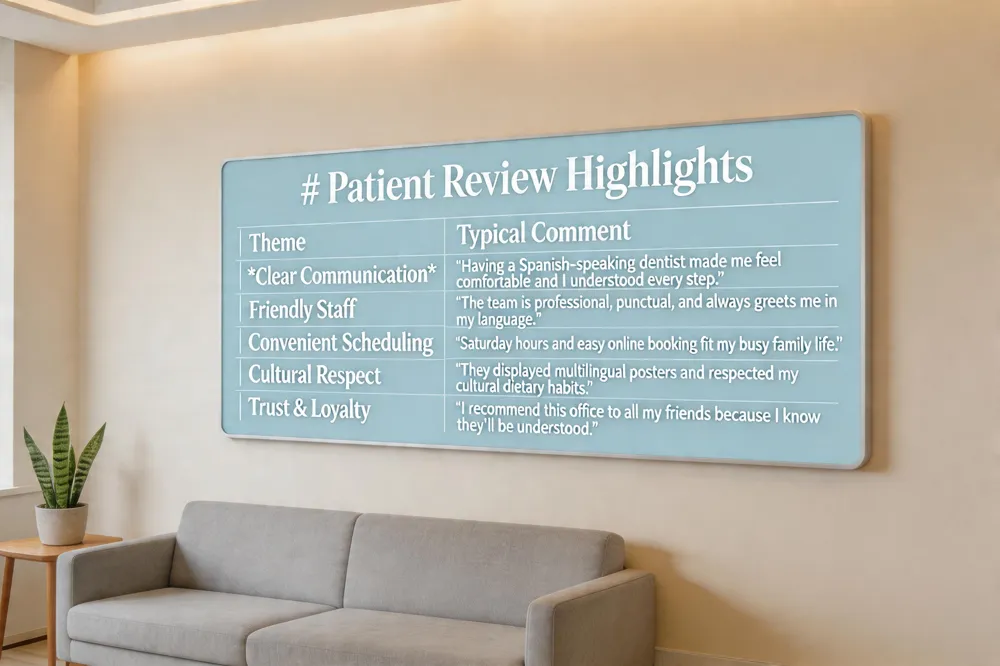 Patient satisfaction with bilingual practices is high because clear communication reduces anxiety and improves understanding of treatment plans. At Totowa clinics such as Dental Arts of Totowa and NÜVA Smile, reviewers repeatedly praise the friendly, professional staff, easy scheduling, and the ability to speak Spanish or other languages. Dr. Zoya Mitelberg is described as gentle and excellent at explaining procedures, making anxious patients feel comfortable. Minimal wait times, punctual appointments, and Saturday hours add convenience. Cultural sensitivity—visible in multilingual materials, respectful décor, and personalized care—builds trust and encourages loyalty, leading many patients to recommend these practices to friends and family.
Conclusion
Effective communication and cultural sensitivity are essential for successful dental treatment; they reduce anxiety, improve understanding of oral‑health instructions, and lead to better outcomes. Families benefit most when they can receive care from bilingual providers who respect cultural preferences and offer flexible, comprehensive services under one roof. Dental practices should prioritize hiring multilingual staff, providing translated materials, and embedding cultural‑competence training into daily operations. By doing so, they create welcoming environments that encourage regular check‑ups, increase patient satisfaction, and close oral‑health gaps in diverse communities. Choose a practice that embraces these principles to ensure comfortable, personalized care for every family member.