Quick Guide to Light‑Weight Cosmetic Options
Cosmetic bonding is a single‑visit, minimally invasive treatment that applies a tooth-colored composite composite directly to the tooth surface. The resin is sculpted, light‑cured and polished, repairing chips, small gaps, minor discoloration or shape irregularities while preserving most enamel. Porcelain veneers are thin ceramic shells bonded to the front of the tooth after a slight (≈0.3–0.7 mm) enamel reduction. They mimic translucency, resist stains and can last 10‑15 years or more.
Key differences: bonding usually costs $100‑$600 per tooth, requires no lab work and finishes in one 30‑60‑minute appointment; veneers cost $800‑$2,500 per tooth, need two‑to‑three visits and irreversible enamel removal.
Patients seeking a quick, upgrade for a chip, narrow gap or mild discoloration benefit most from bonding, while those wanting a longer‑lasting transformation across multiple teeth may prefer porcelain veneers.
Cosmetic Bonding: Fast, Minimal Invasion, and Budget Friendly
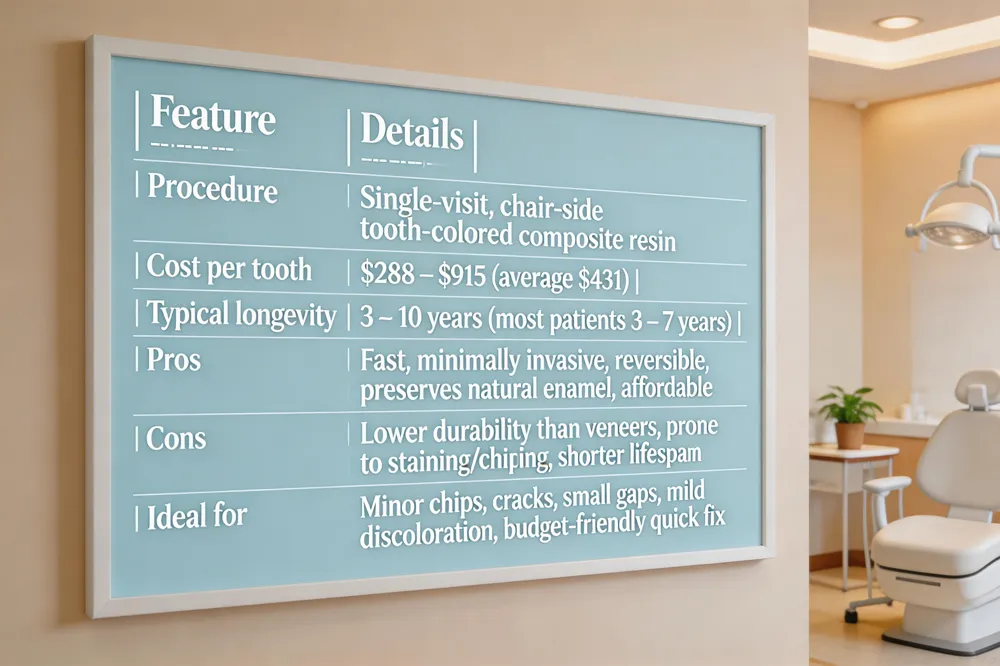
| Feature | Details |
|---|---|
| Procedure | Single‑visit, chair‑side application of tooth‑colored composite resin |
| Cost per tooth | $288 – $915 (average $431) |
| Typical longevity | 3 – 10 years (most patients 3 – 7 years) |
| Pros | Fast, minimally invasive, reversible, preserves most natural enamel, affordable |
| Cons | Lower durability than veneers, prone to staining/chipping, shorter lifespan |
| Ideal for | Minor chips, cracks, small gaps, mild discoloration, patients seeking quick, budget‑friendly fix |
 Dental bonding is a quick, single‑visit solution that uses a tooth‑colored composite resin applied chair‑side. The dentist roughens the tooth surface, matches the resin shade to your natural teeth, sculpts the material, and cures it with a blue light—no drilling or extensive enamel removal is needed, so the procedure is virtually painless. Most patients feel only a brief warmth from the curing light, and any post‑treatment sensitivity usually fades within a day or two.
Because bonding preserves the majority of your natural tooth structure, it is reversible and ideal for minor chips, cracks, small gaps, or mild discoloration. The result is an immediate, natural‑looking restoration that blends seamlessly with surrounding teeth. In Totowa, New Jersey, Best Choice Dental offers this minimally invasive service using advanced digital scanning and high‑quality composite materials, ensuring precise shade matching and a comfortable experience.
Cost is a major advantage: bonding typically runs $288‑$915 per tooth (average $431), far less than porcelain veneers, which can cost $800‑$2,500 per tooth. While bonding lasts 3‑10 years—depending on oral habits and care—veneers can endure 10‑15 years with superior stain resistance. For patients seeking a budget‑friendly, fast cosmetic upgrade, bonding provides an effective, personalized solution that fits comfortably into a busy schedule.
Porcelain Veneers: The Gold Standard for Long‑Lasting Aesthetics
| Feature | Details |
|---|---|
| Procedure | Custom‑fabricated porcelain shells; requires 0.3 – 0.7 mm irreversible enamel removal |
| Cost per tooth | $800 – $2,500 (New Jersey) |
| Typical longevity | 10 – 15 years or more with proper care |
| Pros | Highly durable, excellent stain resistance, natural translucency, long‑term value |
| Cons | Irreversible enamel removal, higher cost, multiple appointments, potential sensitivity |
| Ideal for | Severe discoloration, larger gaps, extensive aesthetic concerns, patients des premium, long‑lasting results |
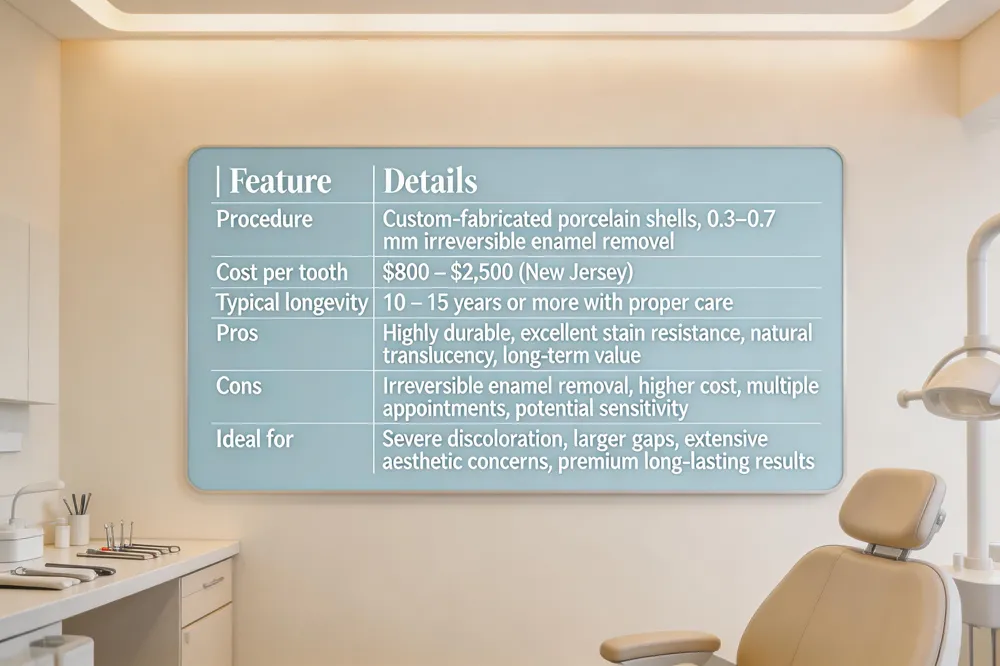 Porcelain veneers are custom‑fabricated shells that require a small, irreversible enamel removal (≈0.3‑0.7 mm) to achieve a precise fit. This laboratory‑crafted process gives each veneer a natural translucency and superior stain resistance, allowing a smile that can last 10‑15 years or more with proper care. The treatment typically involves at least two appointments: a preparation visit and a placement visit after the lab creates the final restoration. Costs reflect the lab work and material quality—porcelain veneers range from $800 to $2,500 per tooth in New Jersey, whereas cosmetic bonding is a budget‑friendly alternative at $100‑$400 per tooth and can be completed in a single visit.
Pros and Cons
- Veneers: durable, highly stain‑resistant, natural appearance, long‑term value; cons: irreversible enamel removal, higher cost, multiple visits, potential sensitivity.
- Bonding: quick, minimally invasive, affordable, reversible; cons: lower durability, prone to staining/chipping, lifespan of 3‑7 years.
When Dentists Advise Against Veneers Patients with severe bruxism, extensive decay, untreated gum disease, or poor oral hygiene may be steered toward bonding or other conservative options, as veneers require healthy tooth structure and can exacerbate sensitivity or failure if underlying issues are not addressed.
Comparing Bonding, Veneers, and Porcelain Bonding uses composite resin directly on the tooth for minor fixes; veneers—especially porcelain—provide a custom, long‑lasting, stain‑resistant solution for more extensive cosmetic concerns. Porcelain remains the premium material for veneers, offering the best durability and aesthetic match to natural teeth.
Making the Right Choice for Your Totowa Smile
| Decision Factor | Guidance |
|---|---|
| Aesthetic Goal | Quick fix for tiny chip/gap → bonding; dramatic, lasting transformation → porcelain veneers; extensive damage → crown |
| Budget | Bonding $100 – $600 per tooth; veneers $800 – $2,500 per tooth; crowns $1,000 – $2,500 per tooth |
| Oral Health | Ensure no untreated decay, gum disease, or uncontrolled bruxism before any cosmetic work |
| Treatment Complexity | Bonding = 1 visit (30‑60 min); veneers = ≥2 visits (prep + lab work); crowns = 2‑3 visits |
| Provider Options in Totowa | Best Choice Dental, Dental Arts of Totowa, Perfect Smiles – all offer digital imaging & multilingual staff |
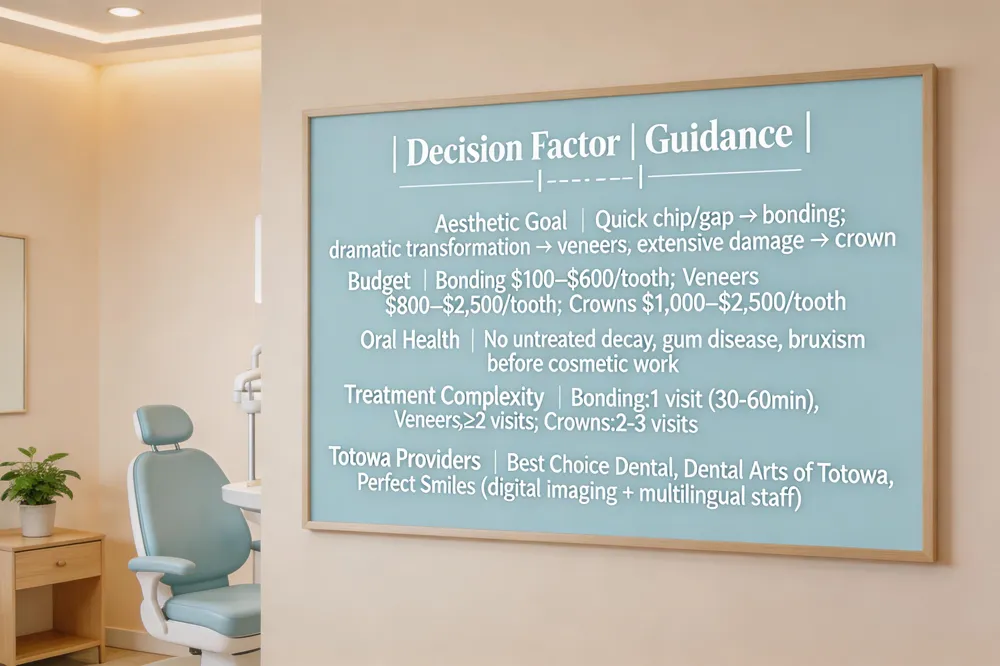 When deciding how to enhance your smile, start with your aesthetic goals. If you only need a quick fix for a tiny chip or a minor gap, dental bonding—completed in one 30‑60‑minute visit—offers a budget‑friendly, minimally invasive solution that preserves most of the natural enamel. For a more dramatic, long‑lasting transformation—such as correcting severe discoloration, larger gaps, or reshaping multiple teeth—porcelain veneers provide superior stain resistance, natural translucency, and a lifespan of 10‑15 years or more. When a tooth is heavily damaged, cracked, or requires a core buildup, a crown encases the entire visible portion and delivers the greatest strength, though it involves the most tooth reduction.
Oral health assessment is essential. A thorough exam will reveal any untreated decay, gum disease, or bruxism that must be addressed before any cosmetic work. Good oral health ensures the longevity of the chosen restoration.
Budget considerations matter. Bonding typically costs $100‑$600 per tooth, veneers $800‑$2,500 (porcelain) per tooth, and crowns are often $1,000‑$2,500. Insurance may cover preventive work, but most cosmetic procedures are out‑of‑pocket, so explore financing options.
Local providers in Totowa include Best Choice Dental (418 Union Blvd) with Dr. Gryzmolowicz, Dental Arts of Totowa (547 Union Blvd) under Dr. Mitelberg, and Perfect Smiles (9 Furler St) led by Dr. Maher and Dr. Colarusso. All offer digital imaging, personalized care, and multilingual staff.
Comparing bonding, veneers, and crowns: bonding is the most conservative and affordable, veneers offer a balance of durability and aesthetics, and crowns provide the strongest protection for severely compromised teeth. Review before‑and‑after photos on each practice’s website to visualize potential outcomes and make an informed decision that aligns with your smile goals, oral health, and budget.
Aftercare, Maintenance, and Lifestyle Factors
| Care Aspect | Recommendation |
|---|---|
| Oral Hygiene | Brush twice daily with soft‑bristled brush, floss daily, regular cleanings at Totowa office |
| Staining Foods/Beverages | Limit coffee, tea, red wine, tobacco; rinse promptly or use a straw |
| indulging | |
| Sensitivity Management | Use fluoride toothpaste; consider desensitizing gel if needed |
| Financing | CareCredit, flexible payment plans, many insurers cover preventive care (cosmetic procedures usually out‑of‑pocket) |
| Maintenance | Replace or polish bonding if staining occurs; schedule routine check‑ups to monitor veneer integrity |
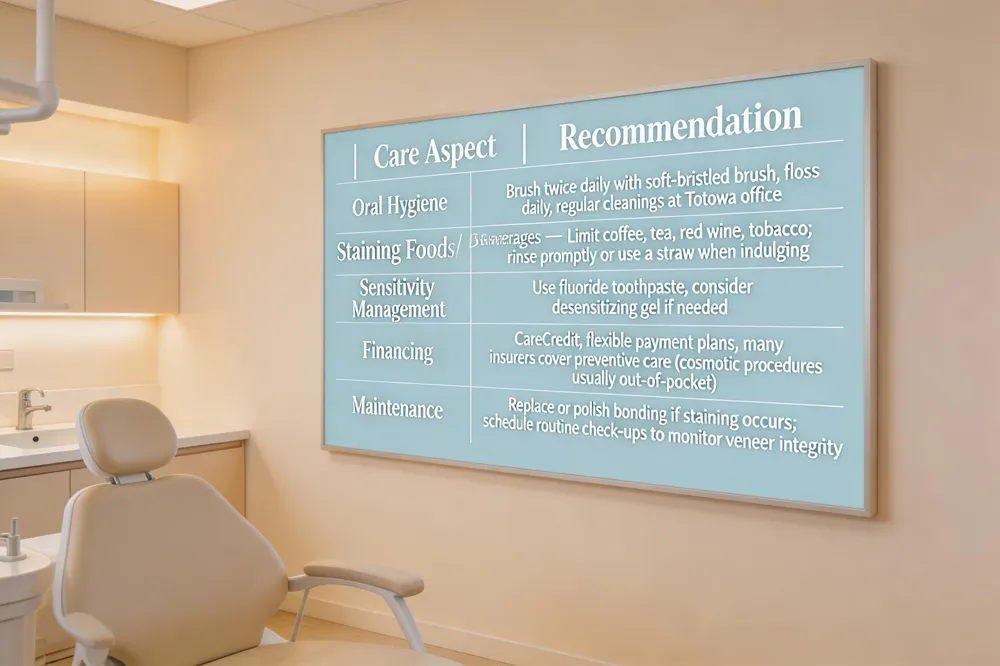 Good oral hygiene is the foundation of lasting results—brush twice daily with a soft‑bristled toothbrush, floss, and schedule regular cleanings at our Totowa office. Avoid staining foods and beverages such as coffee, tea, red wine, and tobacco; if you do indulge, rinse promptly and use a straw when possible. Sensitivity after bonding or veneers is usually mild; a fluoride toothpaste and, if needed, a desensitizing gel can soothe discomfort. Our team works with many insurers and offers flexible financing (CareCredit, payment plans) to fit any budget. A wider smile enhances facial balance and symmetry, making the face appear more inviting and confident. SmileKit at‑home kits provide an affordable whitening boost, but results are temporary, may increase sensitivity, and lack professional supervision. Dental bonding is a cost‑effective way to repair chips or gaps, offering natural‑looking results that can endure for years with proper care
Quick FAQ Summary
| Question | Answer |
|---|---|
| How much does 1‑tooth composite bonding cost? | $200 – $400 (typical range $100 – $600) |
| How long does bonding last? | Approximately 3 – 7 years (up to 10 years with optimal care) |
| How long do porcelain veneers last? | 10 – 15 years or more with proper oral hygiene |
| Main pros of bonding? | Fast, minimally invasive, reversible, budget‑friendly |
| Main cons of bonding? | Lower durability, more prone to staining/chipping |
| Main pros of veneers? | Superior aesthetics, high stain resistance, long‑lasting durability |
| Main cons of veneers? | Irreversible enamel removal, higher cost, multiple visits |
| When to choose a crown over bonding/veneers? | When the tooth is heavily damaged, cracked, or requires core buildup for maximum strength |
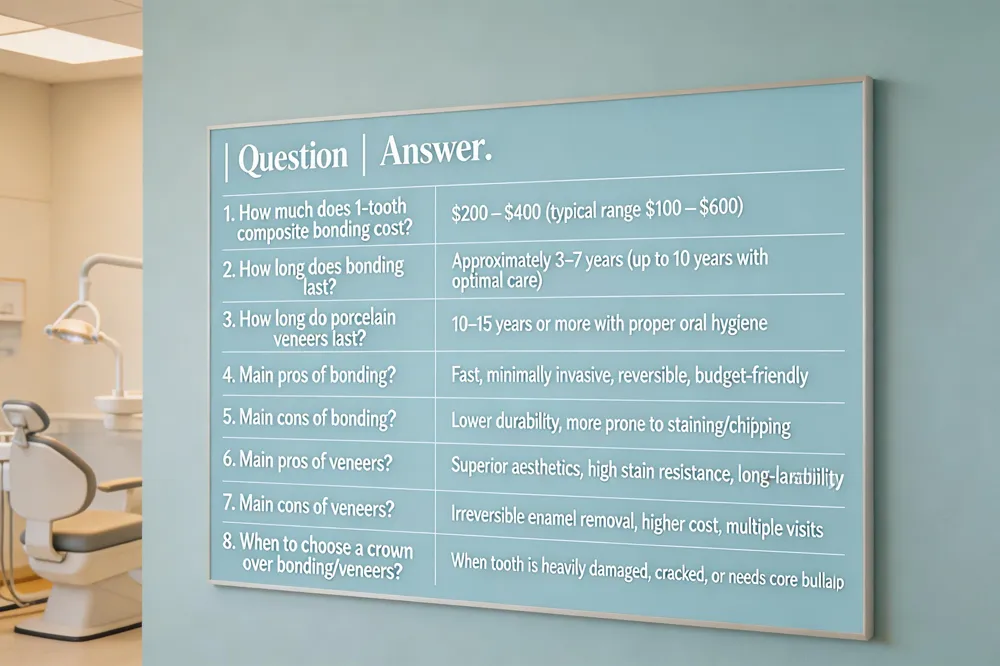 Key Takeaways: Dental bonding is a fast, minimally invasive, and budget‑friendly option for small chips, gaps, or mild discoloration. Porcelain veneers offer a premium, long‑lasting (10‑15+ years) solution for more extensive cosmetic concerns.
Common Concerns: Patients often wonder about durability, staining, and the permanence of treatment. Bonding is reversible and may stain over time; veneers are permanent but resist stains and wear.
Cost Snapshots: One‑tooth composite bonding typically costs $100‑$400 (often $200‑$400 in the US). Porcelain veneers run $800‑$2,500 per tooth, requiring lab work and multiple visits.
Longevity Comparison: Bonding lasts ~3‑7 years; porcelain veneers last 10‑15 years or more with proper care.
FAQ
- How much does 1 tooth composite bonding cost? $200‑$400.
- Cosmetic bonding vs veneers vs porcelain – Bonding uses resin for quick fixes; veneers (porcelain or composite) cover the front; porcelain veneers give the most natural look and durability.
- Cosmetic bonding vs veneers cost – Bonding $100‑$400, one visit; porcelain veneers $800‑$2,500, multiple visits, 10‑15 year life.
- Bonding vs veneers pros and cons – Bonding: low cost, quick, reversible, but 3‑7 yr life, stains. Veneers: superior aesthetics, stain‑resistant, long‑term value, but higher cost, irreversible enamel removal.
- Bonding vs veneers vs crowns – Bonding for minor repairs; veneers for moderate‑to‑severe aesthetics; crowns for extensive structural damage.
- Dental bonding vs veneers – Bonding: fast, affordable, 3‑7 yr; Veneers: durable, natural‑looking, 10‑15 yr, higher cost.
Final Thoughts on Light‑Weight Smile Upgrades
Both dental bonding and porcelain veneers give you a brighter smile, but they differ in durability, cost, and how much tooth structure is altered. Bonding uses a tooth‑colored composite resin applied in a single visit, preserving most of the natural enamel and costing $100‑$600 per tooth; it typically lasts 3‑7 years and may stain over time. Porcelain veneers are custom‑crafted shells that require minimal enamel removal, cost $800‑$2,500 per tooth, and can last 10‑15 years with excellent stain resistance. Because each smile is unique, we recommend a personalized consultation at our Totowa office. Our team will assess your oral health, discuss your aesthetic goals, and help you choose the option that fits your budget and lifestyle, ensuring a comfortable, lasting result and confidence for a smile you’ll love every day, peace.