Understanding Restorative Dentistry
Restorative dentistry is a specialized branch of dental care that repairs or replaces damaged, decayed, or missing teeth to restore normal function and appearance. Tooth damage often stems from cavities, trauma, gum disease, or everyday wear such as grinding. By treating these problems with fillings, crowns, bridges, implants, inlays, onlays, or dentures, restorative dentists not only relieve pain but also prevent further decay, protect surrounding teeth, and maintain proper bite alignment. The result is improved chewing and speech, enhanced smile aesthetics, and a lower risk of infection or bone loss—ultimately supporting better nutrition, confidence, and overall quality of life. Modern practices in Totowa, NJ, such as Best Choice Dental, combine advanced digital imaging, CAD/CAM technology, and personalized treatment plans to deliver comfortable, long‑lasting solutions for patients of all ages.
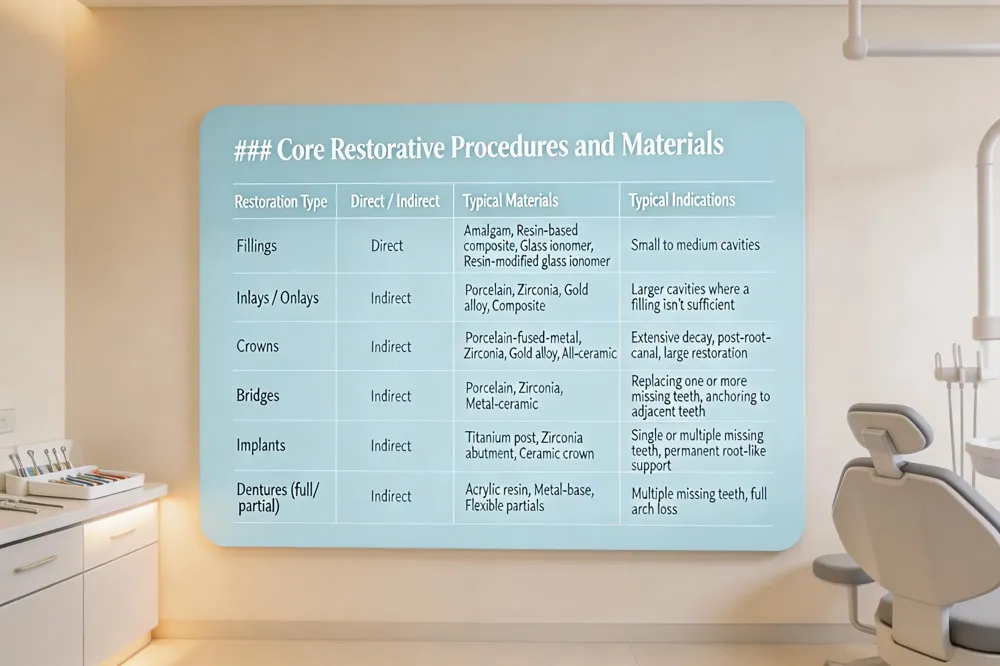
Core Restorative Procedures and Materials
Core Restorative Procedures and Materials
| Restoration Type | Direct / Indirect | Typical Materials | Typical Indications |
|---|---|---|---|
| Fillings | Direct | Amalgam, Resin‑based composite, Glass ionomer, Resin‑modified glass ionomer | Small to medium cavities |
| Inlays / Onlays | Indirect | Porcelain, Zirconia, Gold alloy, Composite | Larger cavities where a filling isn’t sufficient |
| Crowns | Indirect | Porcelain‑fused‑metal, Zirconia, Gold alloy, All‑ceramic | Extensive decay, post‑root‑canal, large restoration |
| Bridges | Indirect | Porcelain, Zirconia, Metal‑ceramic | Replacing one or more missing teeth, anchoring to adjacent teeth |
| Implants | Indirect | Titanium post, Zirconia abutment, Ceramic crown | Single or multiple missing teeth, permanent root‑like support |
| Dentures (full/partial) | Indirect | Acrylic resin, Metal‑base, Flexible partials | Multiple missing teeth, full arch loss |
 Restorative dentistry repairs or replaces damaged, decayed, or missing teeth to restore function and appearance. The dentist first removes decay or damaged tissue, then prepares the tooth for the chosen restoration—whether a filling, crown, bridge, or implant. Materials such as tooth‑colored composite, porcelain, or metal are customized to match natural teeth and bonded or cemented into place. After placement, the bite is checked and adjustments are made for comfortable chewing and speech. Regular follow‑up care helps the restoration last for years while maintaining optimal oral health.
Dental restoration materials are classified into direct and indirect types. Direct materials—amalgam, resin‑based composites, glass ionomers, and resin‑modified glass ionomers—are placed directly into cavities. Indirect materials—gold alloys, porcelain or other ceramics, zirconia, and titanium—are fabricated in a lab or CAD/CAM unit and then cemented or bonded to the tooth for crowns, bridges, Inlays and onlays, and implants. Selection balances biocompatibility, strength, wear resistance, aesthetic match, and cost, based on the restoration’s location, functional demands, and patient preferences.
Types of restoration include:
- Fillings (composite or amalgam) for small cavities.
- Inlays and onlays custom partial restorations when a filling isn’t enough.
- Crowns encircling the entire visible tooth for extensive decay or after root‑canal therapy.
- Bridges and implants replacing missing teeth; bridges anchor to adjacent teeth, implants provide a permanent root‑like foundation.
- Dentures (full or partial) for multiple missing teeth, restoring chewing and speech.
Permanent tooth restoration involves durable solutions such as crowns, implants, bridges, or well‑fitted dentures, all designed to last five years or more with proper oral hygiene and regular check‑ups. At Best Choice Dental in Totowa, NJ, the family‑oriented team tailors each restoration to the individual’s needs, ensuring functional durability and a natural appearance.
Major Restorative Care and Costs
Major Restorative Care and Costs
| Procedure | Price Range (USD) | Typical Materials | Notes |
|---|---|---|---|
| Composite filling | $90 – $250 per tooth | Resin‑based composite | Conservative, aesthetic for anterior teeth |
| Amalgam filling | $80 – $200 per tooth | Dental amalgam | Strong, less aesthetic, often posterior |
| Porcelain / Zirconia crown | $1,200 – $2,500 per tooth | Porcelain, Zirconia, metal‑ceramic | High aesthetics, long‑term durability |
| Gold alloy crown | $1,500 – $3,000 per tooth | Gold alloy | Superior strength, high wear resistance |
| Bridge (2‑unit) | $1,500 – $4,000 | Porcelain, Zirconia, metal‑ceramic | Cost varies by units and material |
| Implant (single tooth) | $3,800 – $14,000 | Titanium post, abutment, ceramic crown | Includes surgery, abutment, crown |
| All‑on‑4 full‑arch | $15,000 – $80,000 | Titanium implants, prosthetic arch | Complex, high‑cost, long‑term solution |
| Veneers (porcelain) | $800 – $2,500 per tooth | Porcelain | Cosmetic, thin shell over enamel |
| Composite veneers | $250 – $600 per tooth | Composite resin | Less expensive, shorter lifespan |
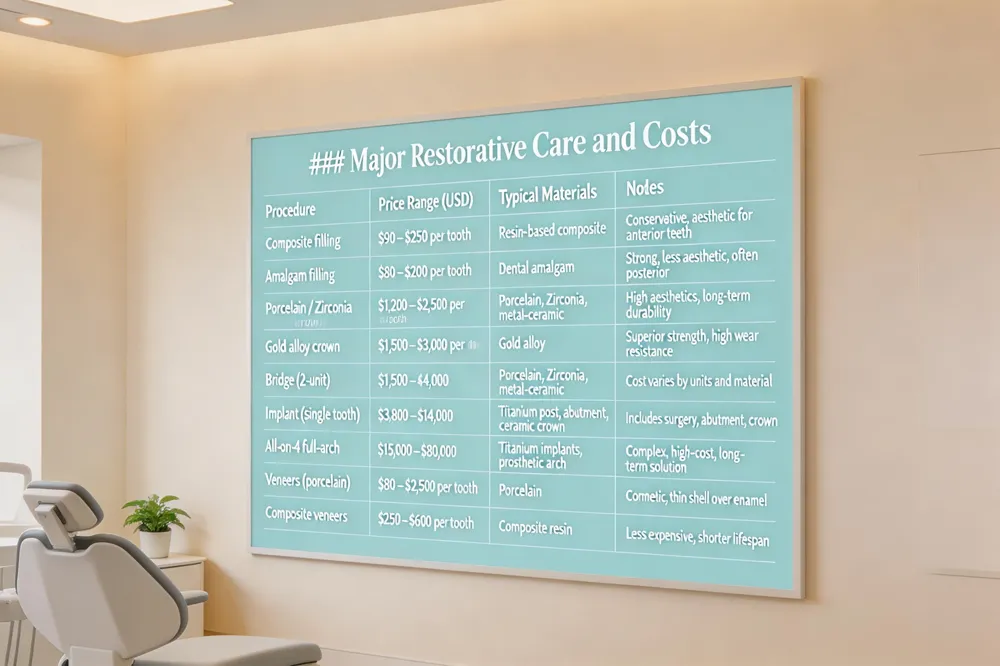 Restorative dentistry goes far beyond basic cleanings and fillings. Major restorative dental services such as crowns, bridges, dentures, and implants repair or replace teeth that have suffered extensive decay, trauma, or loss. These procedures restore function, improve aesthetics, and protect surrounding teeth from further damage. Because they are more involved, insurance often classifies them as “Class 3” services and covers only a portion of the expense.
Price ranges for various restorations vary widely. A simple composite filling typically costs $90–$250 per tooth, while a porcelain or zirconia crown runs $1,200–$2,500. Bridges can range from $1,500 to $16,000 depending on the number of units and whether they are implant‑supported. Dental implants—including the titanium post, abutment, and crown—start around $3,800 for a single tooth and can exceed $14,000 for an all‑on‑4 arch. Full‑mouth reconstructions may run $15,000–$80,000, reflecting the complexity and materials used.
Impact of modern technology on cost is two‑fold. Advanced tools such as digital X‑rays, intra‑oral scanners, CAD/CAM milling, and same‑day crown fabrication increase operational expenses, which are reflected in treatment fees. However, these technologies improve diagnostic accuracy, reduce chair time, and often prevent larger, more costly problems later, offering long‑term savings.
Cost considerations for front‑tooth work include material choice and aesthetic goals. Porcelain crowns for front teeth typically cost $800–$2,000, while veneers range $800–$2,500. Composite resin options are more affordable at $250–$600 per tooth. Insurance may cover a portion of medically necessary restorations, and many practices, including Best Choice Dental in Totowa, NJ, provide flexible financing to make major restorative care more accessible.
Insurance, Financing, and Access in Totowa
Insurance, Financing, and Access in Totowa
| Feature | Coverage Details | Typical Co‑pay | Annual Limit |
|---|---|---|---|
| Preventive exams & cleanings | 100 % covered | $0 – $10 | $1,500 – $5,000 |
| X‑rays (digital) | 100 % covered | $0 – $15 | $1,500 – $5,000 |
| Fillings (basic) | 80–90 % after deductible | $10 – $25 per visit | $1,500 – $5,000 |
| Major restorations (crowns, bridges, implants) | 50–70 % after deductible | $25 – $100 per unit | $1,500 – $5,000 |
| Orthodontics (clear aligners) | Varies by plan, often 50 % | $50 – $150 per visit | $2,000 – $6,000 |
| Financing (CareCredit) | 0 % interest for 6–12 months, then APR | Monthly payments starting at $25 | N/A |
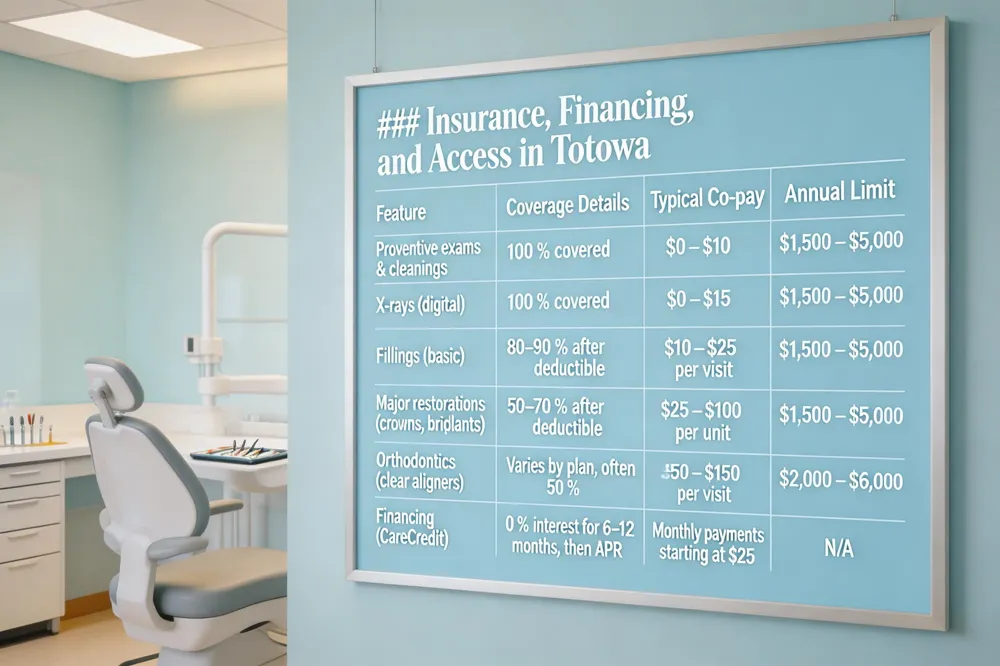 Residents of Totowa have a wide range of options for dental insurance and financing that make restorative care both affordable and convenient. Best Choice Dental insurance offers family‑oriented PPO and indemnity plans with low co‑pays (e.g., $10 for cleanings, $25 per visit) and annual limits from $1,500 to $5,000. Most plans cover routine exams, X‑rays, and major restorative procedures such as crowns, bridges, and implants, with no waiting period for basic services and only a six‑month wait for some intermediate work.
Restorative dental insurance specifically helps pay for treatments that repair or replace damaged teeth—fillings, crowns, bridges, dentures, and root‑canal therapy. Coverage typically includes a percentage of the cost after a deductible, with preventive services often covered at 100 % or a minimal copay. Best Choice Dental works with many insurers to maximize these benefits and keep out‑of‑pocket expenses low.
Totowa’s family‑oriented dental practices—including Best Choice Dental, Perfect Smiles, Dental Arts of Totowa, and The Dental Loft—provide comprehensive restorative services using modern technology such as digital imaging, intra‑oral scanners, and CAD/CAM milling.
The practice offers convenient scheduling with evening and Saturday hours, and a multilingual team fluent in Russian, Ukrainian, Arabic, Spanish, and Polish ensures clear communication for the diverse community. Flexible financing options, including CareCredit and small monthly premiums starting at $25, further improve access to high‑quality restorative dentistry for every Totowa family.
Cosmetic and Functional Benefits
Cosmetic and Functional Benefits
| Cosmetic Procedure | Primary Benefit | Typical Material | Expected Longevity |
|---|---|---|---|
| Professional teeth whitening | Immediate shade improvement | Hydrogen peroxide gel | 6–12 months (maintenance) |
| Dental bonding | Repair chips, close gaps | Composite resin | 5–10 years |
| Porcelain veneers | Full‑face smile makeover | Porcelain | 10–20 years |
| Composite veneers | Affordable aesthetic upgrade | Composite resin | 5–7 years |
| Clear‑aligner orthodontics | Straighten teeth discreetly | Clear thermoplastic aligners | 1–3 years (treatment) |
| Crowns (estheticesthetic) | Restore strength & appearance | Porcelain‑fused‑metal, all‑ceramic | 10–15 years |
| Onlays | Reinforce large MOD cavities | Porcelain, Zirconia | 10–15 years |
| Dental implants | Replace missing tooth, preserve bone | Titanium, Zirconia, ceramic crown | 20+ years (with proper care) |
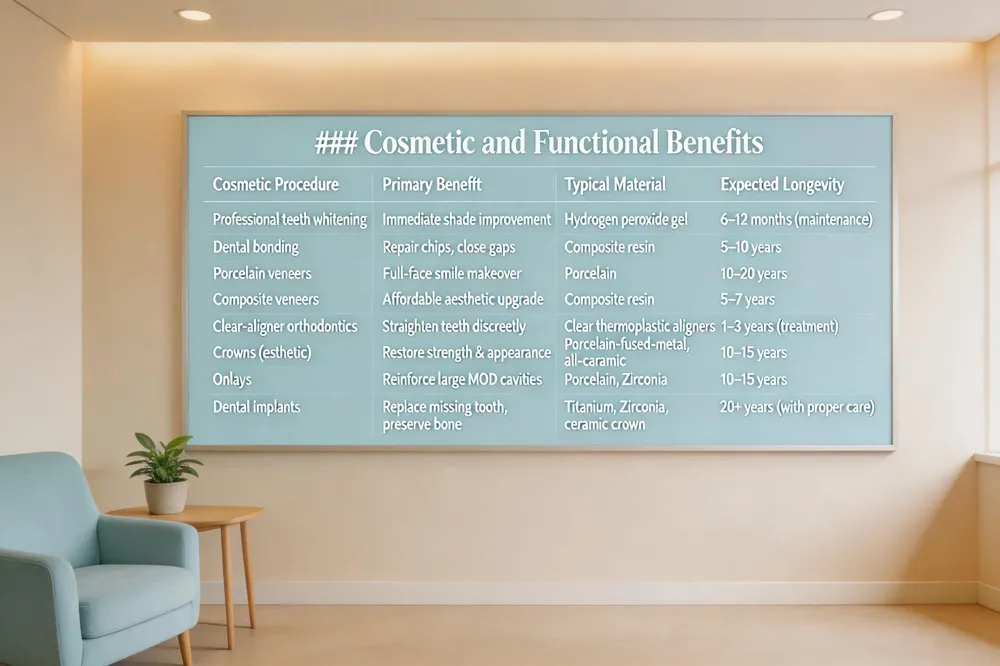 At Best Choice Dental in Totowa, NJ, our family‑oriented team blends cutting‑edge technology with personalized care to deliver both cosmetic and restorative dentistry solutions that enhance your smile’s appearance and function. Popular cosmetic procedures include professional teeth whitening, dental bonding, porcelain veneers, or composite veneers, and clear‑aligner orthodontics; larger restorations such as crowns, onlays and dental implants not only replace missing teeth but also provide a natural‑looking, durable aesthetic. By brightening a smile, closing gaps, and reshaping chipped or misaligned teeth, cosmetic work instantly boosts confidence, encouraging patients to engage socially and professionally without hesitation. Many of these treatments overlap with restorative goals—crowns, onlays, and dental implants protect weakened tooth structure, distribute chewing forces evenly, and prevent further decay, while also delivering a seamless look that matches surrounding teeth. The long‑term value of aesthetic restorations lies in their durability; modern materials like high‑strength ceramics and CAD/CAM‑fabricated crowns can last 15‑20 years or more, reducing the need for frequent repairs and preserving oral health. Ultimately, investing in restorative dentistry restores proper function, prevents future complications, and offers lasting, beautiful results that support overall well‑being for patients of all ages.
Patient Guidance and Future Care
Patient Guidance and Future Care
| Step | Action | Recommended Material / Tool | Desired Outcome |
|---|---|---|---|
| 1 | Early detection | Regular exams, digital X‑rays, intra‑oral scanner | Identify decay before it worsens |
| 2 | Minimal invasive treatment | Composite filling for small lesions | Preserve tooth structure |
| 3 | Moderate damage | Inlay or onlay (porcelain or zirconia) | Provide strength while maintaining aesthetics |
| 4 | Extensive loss | Crown (all‑ceramic or metal‑ceramic) | Full coverage, durability, bite stability |
| 5 | Missing tooth | Bridge or implant (titanium post + crown) | Restore function, prevent adjacent tooth drift |
| 6 | Full arch loss | Full‑mouth dentures or implant‑supported prosthesis | Re‑establish chewing efficiency and speech clarity |
| 7 | Ongoing maintenance | Daily brushing, flossing, fluoride use, regular check‑ups | Longevity of restorations and overall oral health |
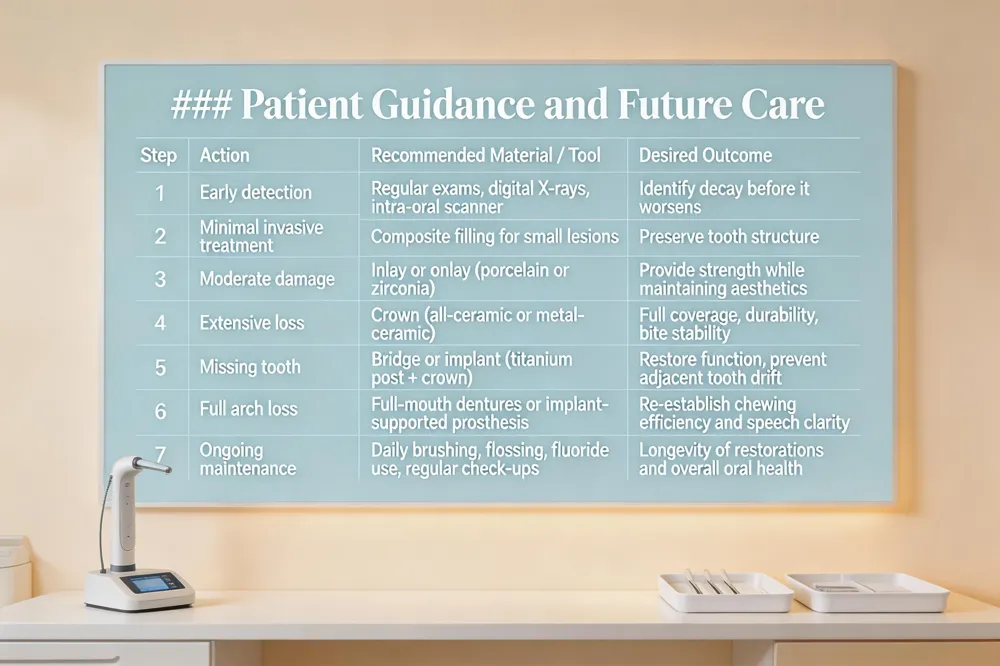 Steps for successful buccal restoration: A buccal restoration rebuilds the cheek‑side surface of a damaged tooth. The dentist removes decay, cleans the area, then places a tooth‑colored composite, porcelain veneer, or onlay. For larger defects an indirect onlay or crown is fabricated in a lab for added strength and a sealed interface that protects any root canal filling. Material choice depends on remaining tooth structure, tooth location, and bite forces; a well‑placed restoration improves aesthetics, prevents further deterioration, and restores normal chewing.
Education pathway to become a dentist: To practice in the U.S., earn a bachelor’s degree with science prerequisites, then complete a four‑year DDS or DMD program at an accredited dental school. Admission requires a strong DAT score and references. After graduation, pass the National Board exams and obtain a state license. Many dentists pursue residency training for specialty fields.
Best overall approach to restoring teeth: Early detection and minimally invasive, tooth‑conserving treatments are key. Regular exams, fluoride brushing, flossing, and sealants prevent decay. Small cavities are treated with composite fillings; larger damage uses crowns or onlays; missing teeth are replaced with bridges or implants for long‑term stability. Combining preventive care with timely restorative procedures yields the healthiest, most functional smile.
Choosing Restorative Care in Totowa
Restorative dentistry restores both function—chewing, speaking, bite stability—and aesthetics, giving you a confident smile while protecting remaining teeth from decay and misalignment. At Best Choice Dental, Dr. Sung Choi and his team combine family‑oriented care with cutting‑edge technology such as digital X‑rays, intra‑oral scanners, CAD/CAM milling and same‑day C fabrication. This precise, comfortable approach ensures each filling, crown, bridge or implant fits naturally and lasts longer. We invite Totowa residents to schedule a comprehensive evaluation, where we’ll create a personalized treatment plan that safeguards oral health and enhances your everyday quality of life.